Apple Watch vs Garmin for running
Most of these comparisons are spec sheets. Here's the more useful frame: figure out whether the thing pulling you across is hardware or software, because only one of those requires buying a new watch.
Garmin or Apple Watch for running: the short answer
- Choose Garmin. if you need multi-week battery life, reliable physical buttons, an outdoor-first display or enough endurance for ultras and long days off-grid.
- Choose Apple Watch. if you want the stronger everyday smartwatch, deep iPhone integration and excellent running accuracy for road training through the marathon.
- Keep the watch you already own. if its battery, buttons and running accuracy already work for you. Frustration with the app experience, daily guidance or lack of a useful AI conversation is a software problem.
- Try Rayvik for the coaching layer. if you want a proactive, personalized coach that turns recovery and training data into a daily decision—and remembers your goals, training history and injuries. Apple Watch is supported today; Garmin support is planned.
In one line: switch watches for battery, buttons or outdoor hardware—not just for an algorithm. If coaching is the gap, improve the software layer first.
What actually differs for runners
| APPLE WATCH | GARMIN (RUNNING MODELS) | |
|---|---|---|
| Battery | ~24–42 hrs by model; daily charging routine | Days to weeks, model-dependent; ultra-proof |
| Controls | Touch-first; Action Button on Ultra | Physical buttons throughout; better in rain and intervals |
| GPS & HR accuracy | Top tier (dual-frequency on Ultra) | Top tier (dual-frequency on many models) |
| Native training guidance | Training load; no native readiness verdict | Training readiness, suggested workouts, race predictor |
| Third-party coaching apps | Deep; HealthKit gives apps the full picture | Closed garden; data flows out via Garmin Connect |
| Everyday smartwatch | The best there is | Functional, not the point |
| Safety features | Fall/crash detection, emergency SOS (cellular models) | Incident detection via paired phone |
Both lineups span many models and change yearly. Treat this as the shape of the trade-off, not a spec sheet for a specific watch.
If hardware isn't the problem, don't replace the hardware
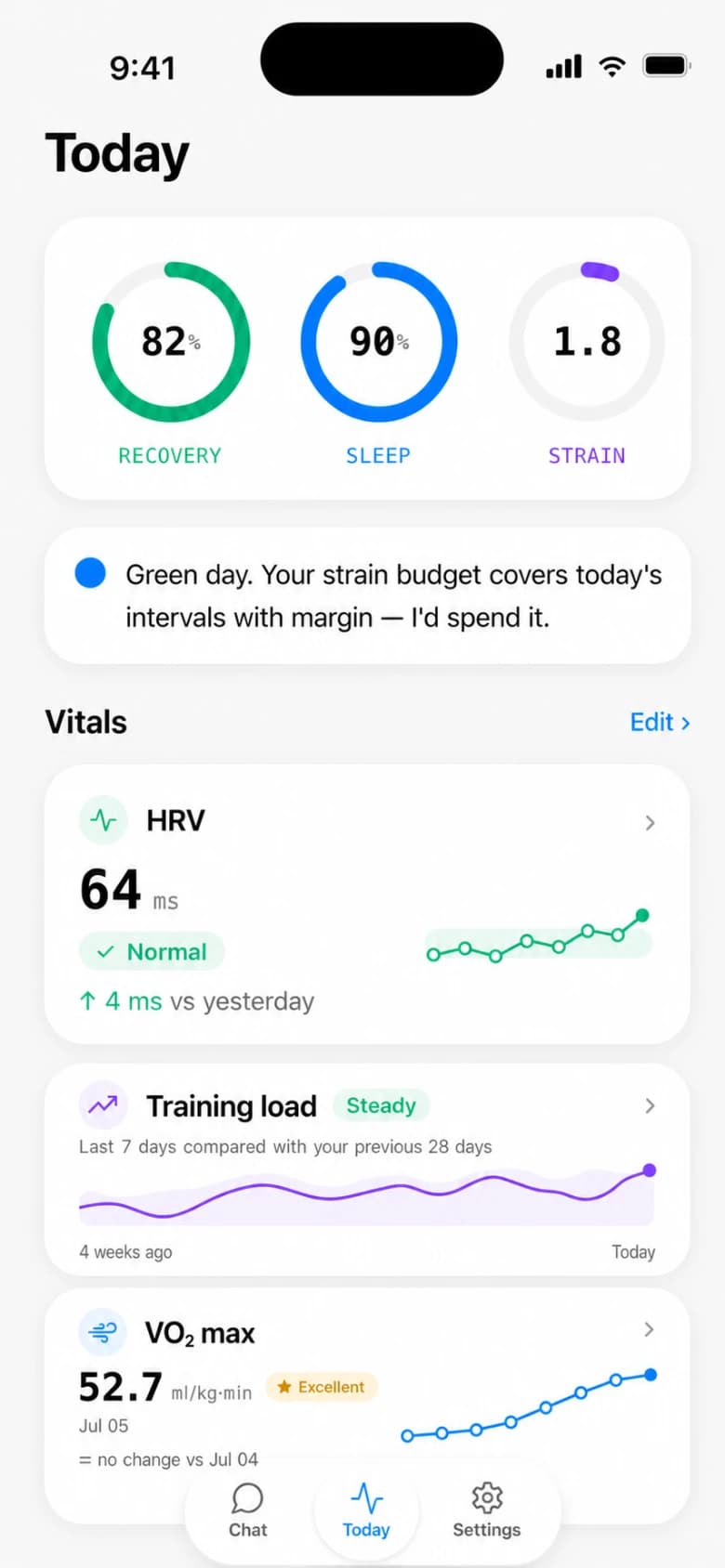
This is where the comparison usually gets muddled. Garmin's readiness score combines sleep, HRV status, recovery time, acute load and recent stress. Apple Watch records much of the same underlying picture, including overnight vitals, workouts and training load. What's missing on the Apple side out of the box is not more sensors. It is the verdict: what do these signals mean for today's training?
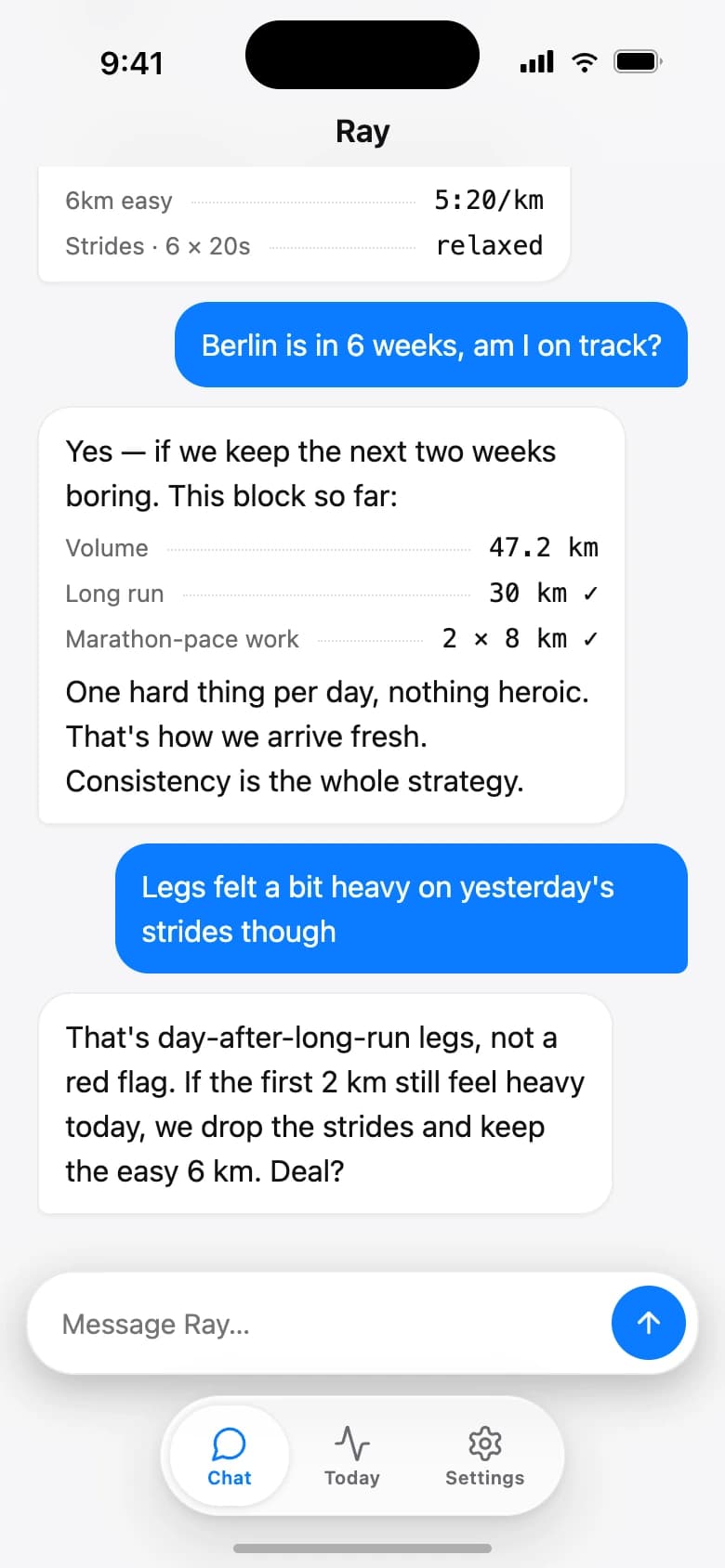
A coaching app can supply that missing layer. The useful version goes further than “readiness 42” to “your recovery is down, so today's tempo becomes an easy 40 minutes.” Recovery apps already close the Whoop-style readiness gap; an adaptive running coach can turn the same signals into a change you can actually train from. Paying $400+ for a new watch is an expensive way to solve that software problem.
From a score to a training decision
That is the product idea behind Rayvik. The coaching layer should be easier to use than a sports dashboard and available as a natural AI conversation. It should be proactive and personal: combining recovery with recent load, remembering your goals, preferences and injury history, then adjusting the session when the evidence calls for it. Your watch keeps collecting; the coach carries the context and tells you what to do next.
Already happy with your Garmin hardware?
Then the same argument runs in the other direction: don't switch to Apple for a coaching app. You would trade away the battery, buttons and running hardware you like to fix something software should fix.
Rayvik supports Apple Watch today, with Garmin support planned. If you like your watch but feel its software stops short of useful coaching, join the beta and select Garmin. We'll let you know when support is ready.
The cases where hardware really decides it
- Go Garmin. if you run ultras or multi-day efforts, need buttons in all weather, want weeks of battery, or spend serious time off-grid where a smartwatch's radios drain fast.
- Stay (or go) Apple Watch. if you wear one watch for everything, value the app ecosystem, want best-in-class safety features, and your longest race fits inside a battery charge, which covers road running up to and past the marathon.
- Either way. don't buy hardware to get an algorithm. Interpretation layers are apps now, on both sides of the fence.
Apple Watch vs Garmin FAQs
Is Garmin or Apple Watch better for runners?
For pure running hardware (battery, buttons, sunlight-readable displays on many models), Garmin wins. As an everyday smartwatch that also runs well, Apple Watch wins. For most recreational runners the honest answer is: the watch you already own is fine, and the training-guidance gap people switch for is increasingly closable with software.
What does Garmin have that Apple Watch doesn't?
Out of the box: multi-week battery life, physical buttons usable mid-interval, and a deeper native training layer with training readiness, daily suggested workouts, race predictions and training status. That last group is software interpreting sensor data, and the Apple Watch collects the same underlying signals; apps can provide the interpretation layer.
Do I need a Garmin if I have an Apple Watch?
Probably not, unless your problem is hardware: you run ultras beyond the battery, you need buttons in the rain, or you want a screen readable in direct alpine sun. If what tempts you is training readiness and daily suggested workouts, that's an interpretation layer over HRV, resting heart rate, sleep and load, data your Apple Watch already records.
Can an Apple Watch replace a Garmin for marathon training?
Yes, for the large majority of road runners. GPS and heart-rate accuracy are in the same tier for both, a 24–42 hour battery comfortably covers any road marathon and training day, and structured-workout and coaching apps fill the guidance gap. The genuine exceptions are ultra-distance battery needs and button preference.
Is COROS as good as Garmin for running?
COROS covers the core running features (excellent battery, light hardware, solid GPS accuracy, plus its own training-load and coaching tools) at typically lower prices, and it's earned a real following among marathoners and trail runners. Its ecosystem is smaller than Garmin's. Garmin can send selected data to Apple Health, while third-party access and detail differ from the native Apple Watch feed; check the coaching apps you want before choosing either ecosystem.
Keep reading
Apple Watch and Garmin are trademarks of their respective owners. Rayvik is an independent app, not affiliated with either watch maker. We build a coaching app for Apple Watch, with Garmin on the roadmap. This guide separates hardware advantages from coaching-software differences using current published facts. Corrections: hey@rayvik.app.