The Whoop alternative on your wrist already
The question behind “should I get a Whoop?” is almost never about the band. It's about wanting someone to tell you whether today should be hard or easy. If you wear an Apple Watch, you already own many of the sensors that inform the answer. What you may be missing is the decision layer.
The short answer
- You want a screenless recovery wearable. This is Whoop's clearest hardware advantage: 24/7 wear, long battery life and a dedicated recovery-and-strain experience.
- You already sleep in your Apple Watch. Keep it. Your existing Health data is already enough to evaluate recovery beside training load; the important choice is what software should do with it.
- You want recovery to change today’s training. Choose Rayvik when you want training load, recovery, injuries and real-life context turned into one clear coaching decision.
I build Rayvik, so this comparison is not neutral and should not pretend to be. I wore a Whoop 5.0 Peak alongside my Apple Watch for about three months. Product facts below are linked to official documentation, my first-hand judgments are labeled, and Rayvik uses no affiliate links.
What Whoop actually gives you
Strip the branding and Whoop is three things: a screenless band you never take off; overnight physiology and sleep data; and software that turns those inputs into a daily recovery score plus a strain target. The hardware is deliberately quiet; the product is the interpretation and the habit of wearing it continuously. WHOOP One is listed at $199 per year in the US, and the core insights require an active membership.
An Apple Watch records many of the same inputs: HRV, resting heart rate, sleep, workout heart rate and wrist temperature on supported models. Apple now provides overnight Vitals and training load, comparing the last 7 days with the previous 28. What it does not do by itself is rewrite a running plan around those signals. The watch can show that your load is high; it does not automatically decide whether today's intervals should be completed, reduced or replaced.
Signal by signal
| SIGNAL | WHOOP | APPLE WATCH |
|---|---|---|
| Overnight HRV | Nightly value from a device designed for continuous wear | Periodic background samples during sleep |
| Resting heart rate | Yes | Yes |
| Sleep stages & duration | Yes | Yes |
| Wrist temperature | Yes | Yes (Series 8+, Ultra, SE 3; not older SE) |
| Workout heart rate | Yes (no screen, no GPS pace) | Yes, plus GPS, pace, power |
| Recovery interpretation | Recovery score + strain target | Needs an app (see below) |
| Battery / night wear | About 10 days in my real-world use (Whoop claims 14+); wear through everything | Charge daily; needs a charging routine for night wear |
| Cost | Subscription from ~$199/yr | Watch you already own + app |
Details vary by model and firmware; both companies revise hardware and pricing regularly. Checked at the time of writing.
The honest Whoop advantages are behavioral as much as technical: a screenless form built for continuous wear, a denser overnight record, much longer battery life and a mature recovery-and-strain loop. Those differences can justify dedicated hardware for someone who cannot or will not wear a watch to bed. If you already sleep comfortably in an Apple Watch, the value question shifts from sensors to software.
Recovery-score apps: what they add—and what they do not
Several iOS apps turn existing HealthKit data into a daily readiness view. They are relevant alternatives to understand, but they largely compete on how the score is calculated and displayed—not on taking responsibility for the training decision.
- Athlytic. Recreates much of the Whoop-style model through daily recovery and exertion scores. That similarity is both the proposition and the limit: the runner still has another number to interpret before deciding what to do.
- Bevel. Combines recovery, sleep and strain in a polished data interface. As more surfaces are added, it increasingly behaves like another health dashboard: useful for inspecting the body, but still separate from the specific run or strength session waiting on the calendar.
- Training Today. Compresses HRV into a deliberately simple readiness number with little setup. That narrowness reduces dashboard work, but the output is still a general verdict rather than a plan-aware coaching decision.
- Gentler Streak. Frames overextension and rest in softer language than ring-closing or performance-first products. The guidance remains broad: it can encourage restraint without necessarily rewriting a goal-specific running session.
These products can add context to the daily “how recovered am I?” question. They do not remove the harder decision: what should today's planned training become? Whichever software you use, wear the watch to sleep and build a reliable charging routine; recovery trends need a consistent overnight record.
A recovery score still is not a training decision
Whoop goes beyond a bare score: it provides a strain target and coaching guidance. The remaining gap is specificity when you already have a running plan. Recovery 34%. Does that mean skip the intervals, shorten them, or move them a day? A general recommendation does not necessarily rewrite the session waiting on your calendar. Community discussions show why the score needs context: Whoop users describe feeling good despite a low recovery score, while Apple Watch users have shown Athlytic and Bevel giving opposite readiness advice from the same health-data source. These are individual user reports, not validation studies, but they illustrate the interpretation problem. A readiness number is an input to a decision; it isn't the decision. That's the line between recovery tracking and adaptive coaching, and it's exactly the gap Rayvik is built to close.
Research supports some restraint here. Reviews of HRV-guided endurance training find potential benefits, but not a consistent performance advantage in every outcome. A single morning signal should inform a decision—not automatically overrule recent training, pain, illness or how the athlete actually feels.
- Start with training load. What have the last seven days of running and strength already asked from you?
- Add recovery and real life. Sleep, HRV and resting heart rate matter alongside soreness, injuries, travel and your own feedback.
- Make one decision. Keep, reduce or replace today's session—and explain why—rather than leaving the runner with another score.
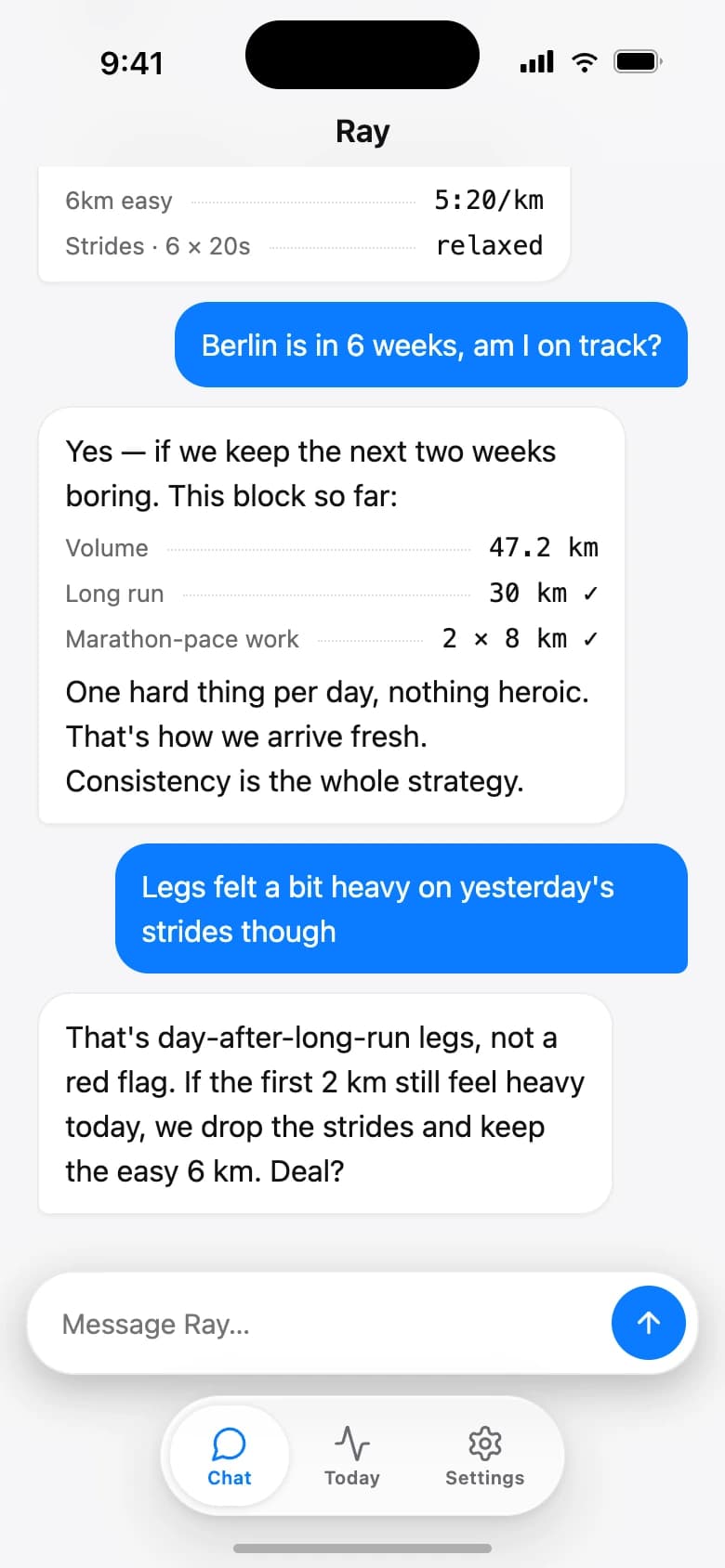
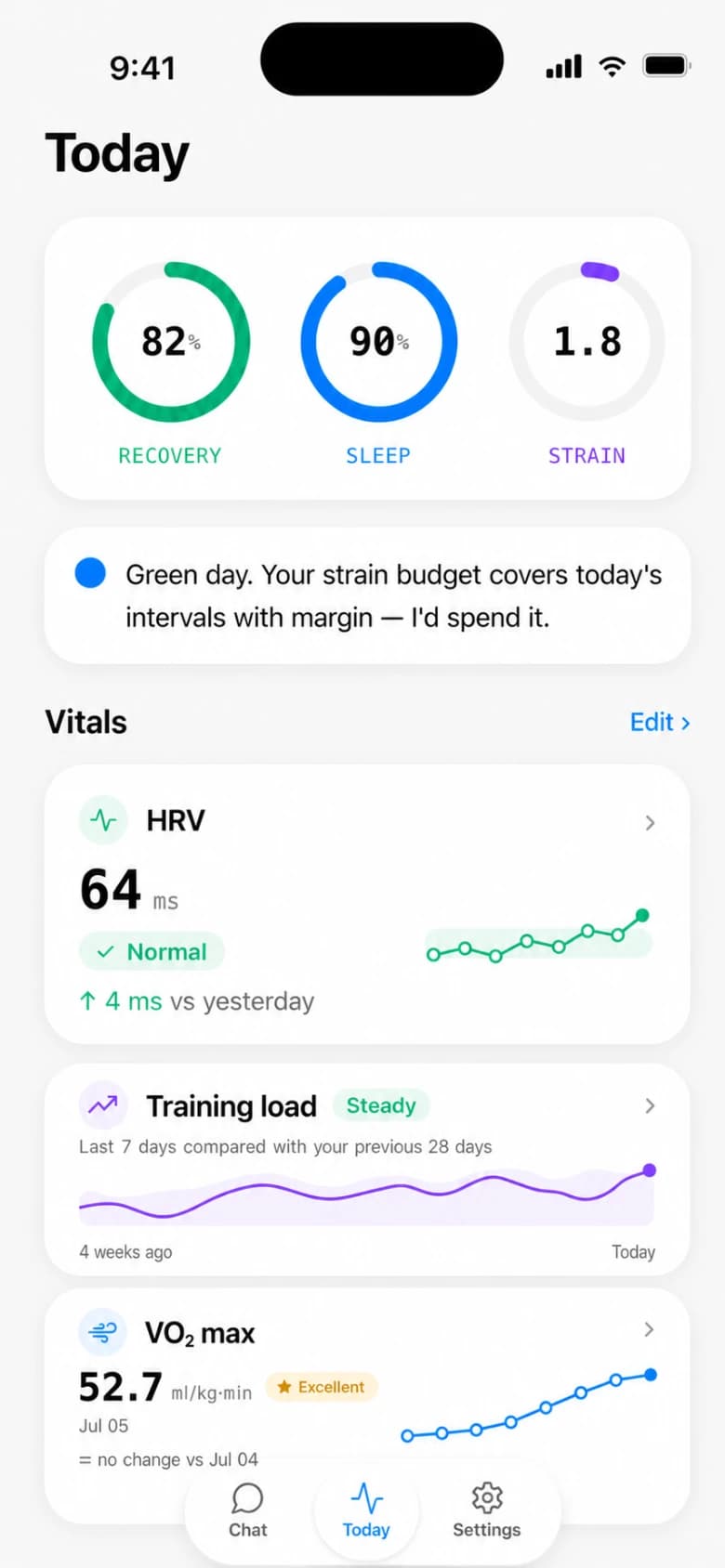
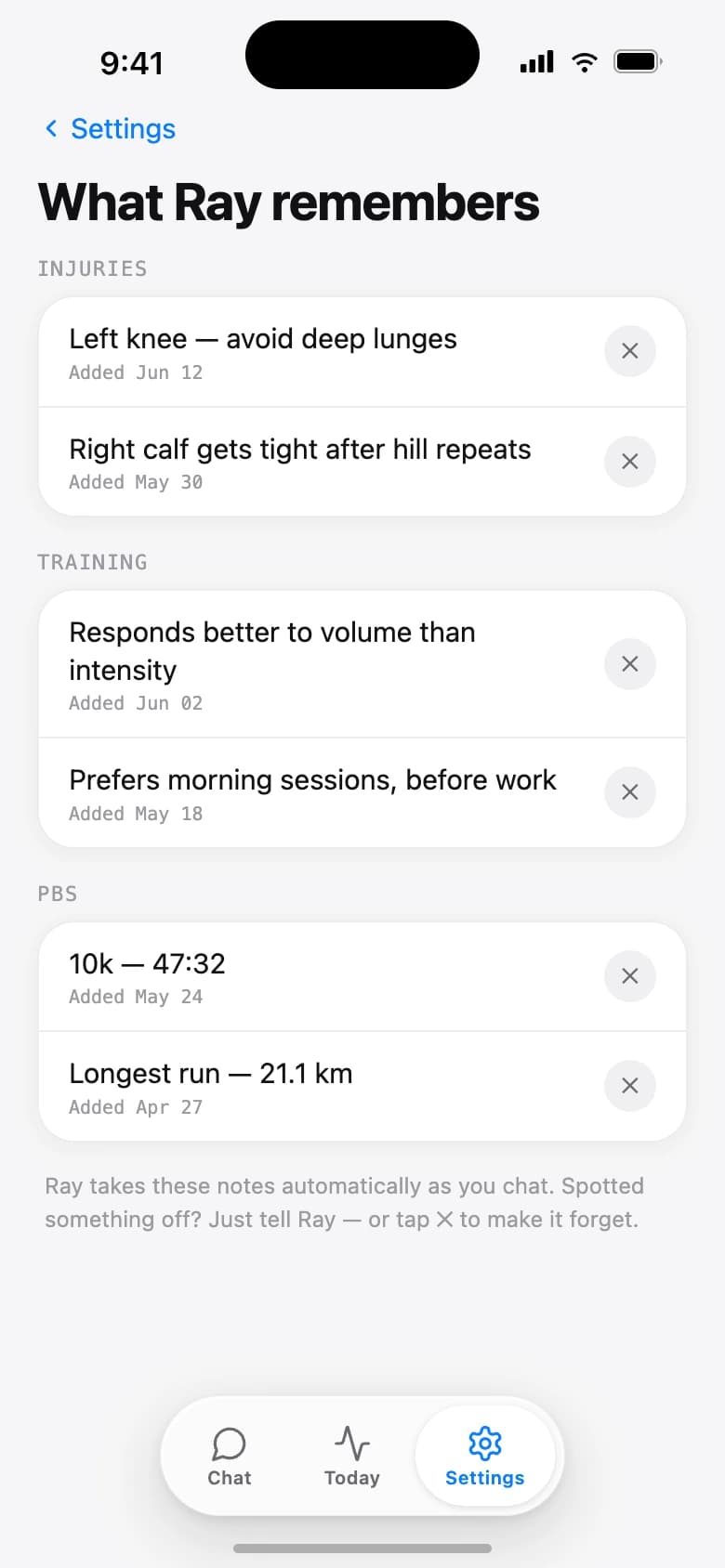
The product claim should be visible, not merely asserted. These screens show the three parts of that decision layer: a natural coaching conversation, a one-minute view of recovery beside training load, and persistent memory of injuries and the way the runner responds to training.
Whoop vs Apple Watch FAQs
Is it worth getting a Whoop if I already have an Apple Watch?
If you already wear your Apple Watch overnight, often not. It records HRV, resting heart rate, sleep and—on supported models—wrist temperature, while third-party apps can add a recovery score. Whoop is still the better fit if you want a screenless device built for 24/7 wear, much longer battery life, denser overnight sensing or its specific recovery-and-strain experience.
Is there an app like Whoop for Apple Watch?
Athlytic, Bevel, Training Today and Gentler Streak use Apple Health data to provide different forms of recovery or readiness guidance. Their main job is scoring and visualization. Rayvik (our app) is designed for a different job: combining recovery with training load, injuries and context to decide what today's planned training should become.
Can an Apple Watch work like a Whoop?
It can provide many of the same inputs, with one practical caveat: you must wear the watch at night and build a daytime charging routine. Whoop is designed for continuous wear and collects a denser overnight record; Apple Watch takes periodic background readings. Whether that difference changes a training decision depends on signal quality, your baseline and how you feel—neither device should overrule pain or illness.
Is Whoop more accurate than Apple Watch?
Independent studies of earlier Apple Watch and Whoop models found broadly comparable sleep/wake detection, but accuracy varies by metric, activity, model and fit. Neither consumer sleep-stage estimate should be treated like a clinical sleep study. A practical difference is sampling density at night, where Whoop measures continuously.
Does Whoop require a subscription?
Yes. WHOOP One is listed at $199 per year in the US, and the core app insights require an active membership. That is the central value question for an Apple Watch owner: do you need Whoop's screenless hardware and product experience, or mainly an interpretation layer for data your watch already records?
Keep reading
Sources & notes
Product facts were checked on July 23, 2026 against Whoop membership details, Whoop's Recovery documentation, Whoop 5.0 battery guidance, Apple's heart-rate documentation, Apple's training-load documentation and current product pages for the apps discussed. Prices, features and compatible hardware vary by region and can change.
Evidence context: Miller et al. (2022) compared earlier Apple Watch and Whoop models with laboratory references for sleep, heart rate and HRV; Bellenger et al. (2021) validated an earlier Whoop model against ECG-derived heart measures. These studies support the usefulness of wearable trends, not equivalence between current devices or clinical-grade sleep staging. A 2021 systematic review of HRV-guided training found that results vary by outcome and method.
Community examples are used only to illustrate user experience, not to establish scientific accuracy: one r/whoop discussion describes the mismatch between perceived readiness and a low recovery score; an r/AppleWatchFitness comparison shows two apps interpreting the same Apple Health source differently.
Disclosure: I build Rayvik, a competing recovery-aware coaching app. My Whoop and Apple Watch observations are first-hand experience, not independent laboratory testing. Rayvik uses no affiliate links.
Whoop, Apple Watch, Athlytic, Bevel, Training Today and Gentler Streak are trademarks of their respective owners. Rayvik is independent of all of them and builds a competing recovery-aware coaching app. Product facts are sourced and experience judgments are labeled. Corrections: hey@rayvik.app.