7 free and paid Runna alternatives
Runna is excellent at turning a race goal into a polished training calendar. These alternatives solve different problems: cost, missed weeks, device lock-in, recovery, or wanting something that feels more like a coach than a plan. One is ours; we label it clearly and include its limitations.
The short answer
- Leaving because of price. Start with Nike Run Club; you save the subscription but give up precise paces and continuous replanning.
- Leaving because you already own a Garmin. Try Garmin Run Coach; you gain device-native data but accept hardware lock-in and denser software.
- Leaving because recovery and life are missing. Consider Rayvik; you gain memory and a recovery-aware conversation but give up Runna's broad device support.
- Leaving because the plan feels too intense. Look at Coopah for a gentler plan and human support; its newer adaptive loop has less independent proof.
If Runna works, you do not need to switch. If it does not, choose the alternative by the exact failure you are trying to fix—not by the longest feature list.
Every switch is a trade. Name the specific thing Runna is not doing for you, then check whether the replacement solves it without removing a feature you rely on.
Free running apps like Runna: what is actually free?
If price is the reason you are leaving, start with a genuinely useful free option before replacing one subscription with another. “Free” can mean a complete plan, a limited tier, an app included with hardware you already own or a time-limited trial.
| APP | FREE ACCESS | THE CATCH |
|---|---|---|
 Nike Run Club Nike Run Club | Complete free plans and guided runs | Less pace precision and no continuous week repair |
| Garmin Run Coach | Included with a compatible Garmin | Not free if you need to buy the watch; model support varies |
 Run With Hal Run With Hal | Free entry point and classic plans | More features and personalization sit in paid access |
 TrainAsONE TrainAsONE | A usable limited free tier | Premium unlocks the fuller adaptive experience |
 Trenara Trenara | A personalized free plan | Advanced edits, strength and controls require paid tiers |
 Rayvik (ours) Rayvik (ours) | Free during beta | iPhone and Apple Watch only; beta rather than a mature public release |
Runna offers a 7-day Premium trial. Without Premium, current support documentation limits plan access to the first week while retaining basic run recording and activity imports. Availability and regional pricing can change.
First, what Runna does well
Runna generates structured plans from 5K through ultra distances, presents the week clearly, prescribes paces, includes strength work and sends workouts to Apple Watch, Garmin, COROS, Suunto and Fitbit. It adapts to performance, so calling it static would be wrong. For a runner who wants a clear race build, broad watch support and polished workout delivery, it remains a strong plan-first paid option in this list.
That polish costs $19.99/month or $119.99/year in the US, with a 7-day trial. Without Premium, current support documentation limits plan access to the first week while retaining basic run recording and activity imports. The question is not whether the training can work—it plainly does for many runners. The question is whether its feedback loop matches the problem you have.
Why runners look for an alternative
- Price. A subscription can feel excessive when you only need one race block or are happy to manage a free plan yourself.
- Intensity. Intervals, tempo work and speed inside long runs are the push some runners love. The same mix can be too ambitious for a beginner, a runner returning from injury or anyone not recovering predictably.
- Recovery is not the centre of the decision. Runna adapts to performance and schedule, but nightly sleep, HRV, resting heart rate and a conversational injury history are not the core daily input.
- A moved workout is not always a repaired week. When work, travel or pain disrupts training, useful coaching must protect spacing between hard sessions—not merely move every unfinished box forward.
- Some runners want an answer, not another dashboard. A plan can show Tuesday's workout. It cannot always answer, in plain language, whether Tuesday still makes sense after two poor nights and a tight calf.
Runna alternatives at a glance
| WHY LEAVE RUNNA? | SWITCH TO | WHAT YOU GAIN | WHAT YOU GIVE UP |
|---|---|---|---|
| The subscription is the problem | Nike Run Club | Free guided audio and straightforward race plans | Precise pace control and continuous plan repair |
| You already paid for the watch | Garmin Run Coach | Sensor-rich daily adaptation with no extra plan fee | Device freedom and a simpler software experience |
| Recovery and life context are missing | Rayvik (ours) | Memory, recovery-aware decisions and conversation | Runna's broad device support and mature public release |
| You want a lower-cost familiar plan | Run With Hal | Proven plans from 5K to 50K with free access | Runna's polish, workout delivery and watch sync |
| A moved run should rebuild the week | TrainAsONE | Continuous algorithmic replanning | A clean calendar and easy-to-follow explanations |
| The plan feels too intense or impersonal |  Coopah Coopah | A gentler plan plus human support | Runna's maturity, ecosystem and stronger independent proof |
| You want cheaper goal-time controls | Trenara | Low-cost physiology-based plans and pace updates | A larger ecosystem and broad public evidence |
Prices and capabilities were checked against official product pages and store listings on August 7, 2026. Exact pricing appears in the reviews below; regional pricing, trials and compatible devices can differ. We use no affiliate links.
7 alternatives, honestly reviewed
This is a decision order, not a universal ranking: start with the free option, the watch you may already own or a coach-first alternative, then compare the specialists.
Nike Run Club — remove the subscription, give up adaptation
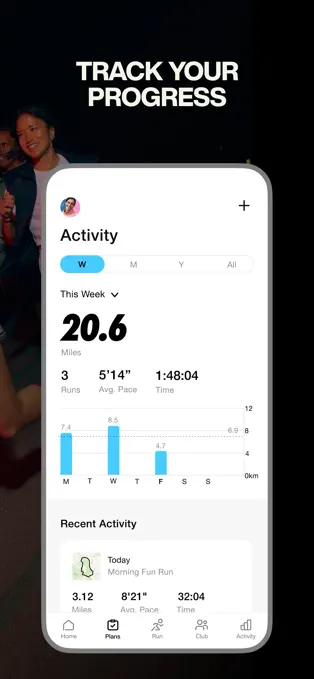
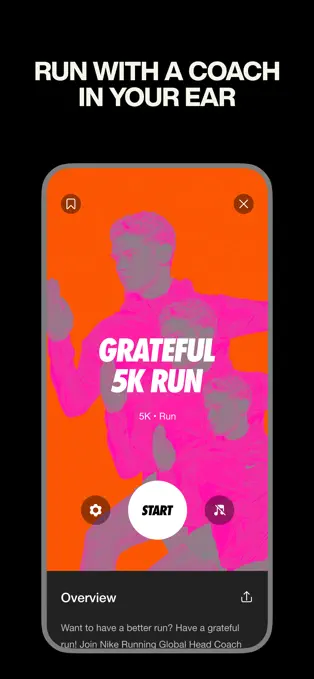
Nike Run Club is the clearest zero-cost option for guided training. Its Audio Guided Runs give the session a coach-like feel that a silent calendar cannot match, and its current listing includes plans from getting started through the marathon. For a first 10K or half, the combination of simple structure, encouragement and Apple Watch support is unusually good for free.
The limit is personalization depth. The plan does not continuously recalculate around completed training, sleep or a disrupted week. Pace control is looser than Runna, plan availability varies by country, and runners using non-Apple watches lose much of the seamless execution. Choose it when motivation and guidance matter more than adaptive planning.

- Completely free, with some of the best guided audio in running.
- Low setup burden and a welcoming experience for first-time racers.
- Apple Watch execution, run tracking and a large global community.
- Plans do not meaningfully rebuild themselves around missed training or recovery.
- Less pace precision and structure control than Runna.
- Plans and guided runs vary by country; non-Apple watch support is limited.
Garmin Run Coach — use the watch you own, accept the lock-in
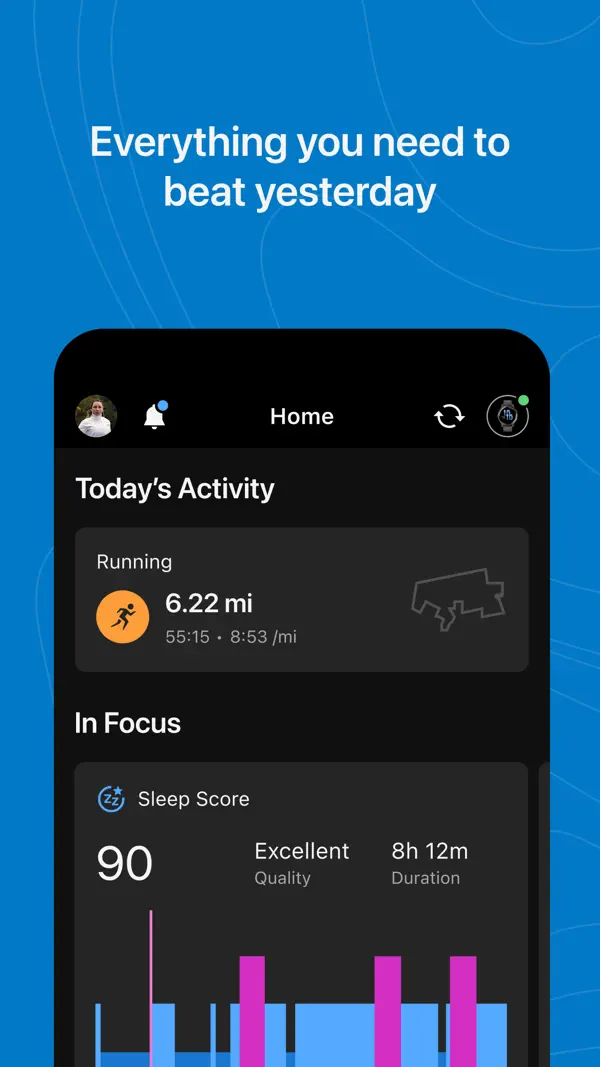
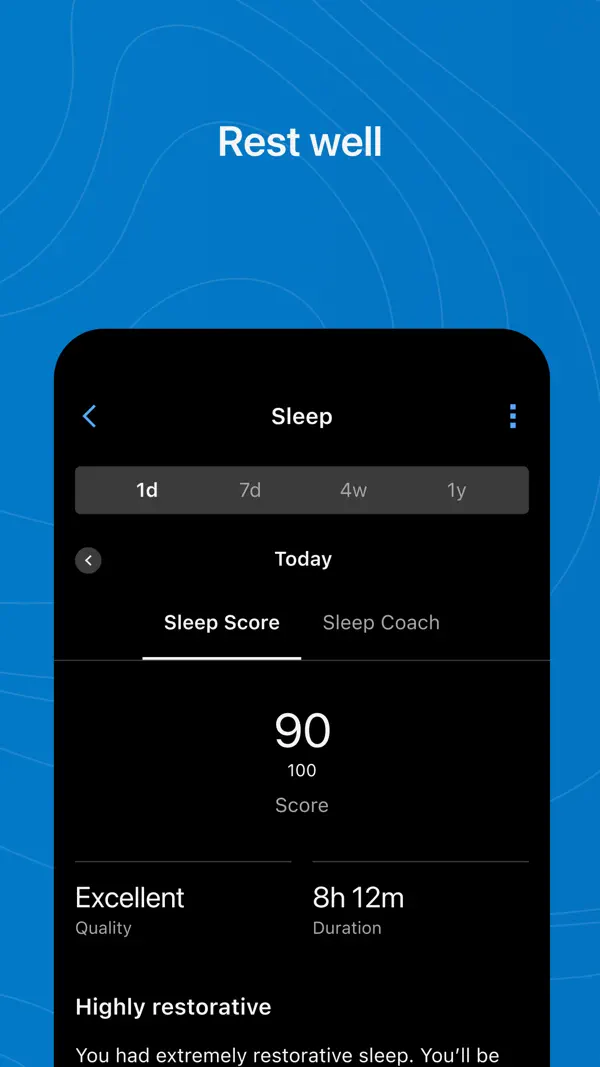
Garmin Run Coach is no longer just the older 5K-to-half-marathon Coach feature. On compatible watches, the newer system supports marathon and custom goals, creates daily workouts, adjusts after missed or extra training and can use sleep, recovery, stress and training-load data. If the hardware is already on your wrist, try this before paying for another plan app.
The catch is the ecosystem. Compatibility varies by model, the best recovery loop assumes near-continuous wear, and Garmin Connect can feel like a wall of menus and metrics. The plan may make a sensible automatic change without explaining it as clearly as a human coach would, and Run Coach workouts cannot simply be dragged to another day. Powerful is not the same as approachable.
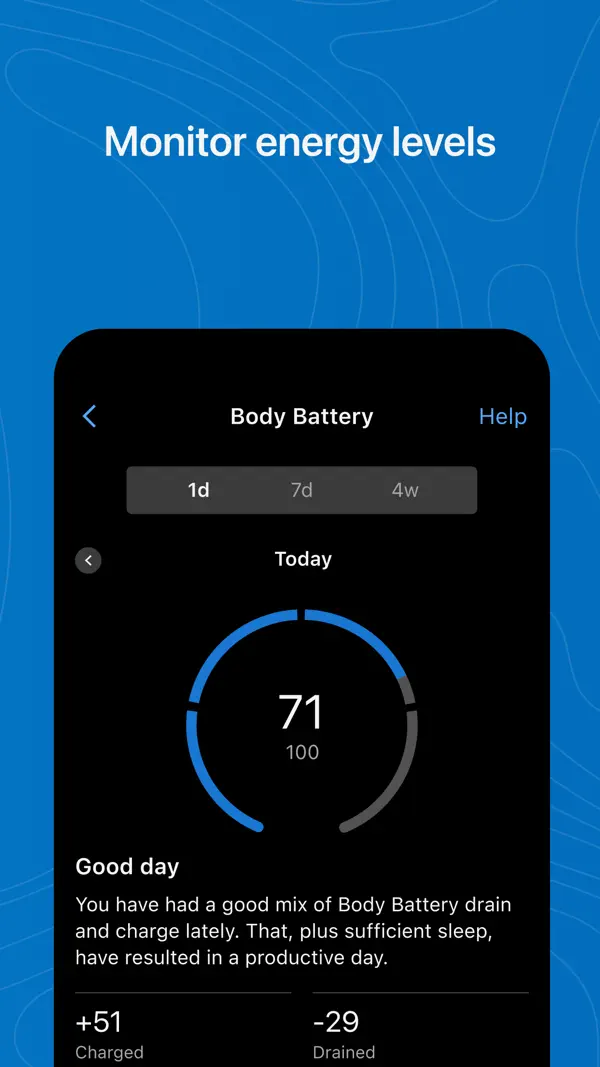
- Uses a deep set of performance, recovery and health signals on compatible watches.
- Repairs the plan after missed or extra training.
- Included with supported Garmin hardware rather than adding a subscription.
- Requires compatible hardware and consistent wear for the full feedback loop.
- Premium hardware is paired with a Garmin Connect experience that feels menu-heavy and fragmented.
- Automatic adaptation can feel opaque, with limited manual rescheduling.
Rayvik — gain recovery context, give up broad device support
We build Rayvik around a simple idea: coaching should feel like iMessage or WhatsApp, not sports-science software. Ask a normal question, mention that your calf feels tight or say that work exploded. You should not need to decode a readiness report—or know the training term for what you are feeling—to get a useful answer. Talk to the AI coach in whatever language feels natural.
The coach is designed to remember your goal, injury history, preferences and the life around the plan: an upcoming trip, a work crunch, a holiday or a recent illness. It can combine that context with Apple Watch runs, sleep, HRV and resting heart rate, then adjust what comes next instead of making you rebuild the week yourself.
That same context informs both sides of coaching: when to push and when to hold back. Rayvik brings running and strength advice into the same conversation, gives immediate feedback while a completed run is still fresh, and starts the morning with a Today glance built for a quick decision—not a report-reading session.
- Text, don’t study. Ask in everyday language and get one clear next step.
- Remembers the runner. Goals, injuries, preferences, travel, illness and near-term plans stay part of the conversation.
- Push and hold back. The coach is designed to recognize when more work helps—and when restraint is the better training decision.
- Run plus strength. Running and strength advice live in the same coaching relationship.
- Feedback while the run is fresh. Get an immediate, easy-to-understand read after training—not just another activity summary.
- One morning glance. Today turns recovery and training context into a fast daily decision.
- Your language, no jargon. Talk to the AI coach in whatever language feels natural—no sports-science vocabulary required.
Rayvik is deliberately focused on iPhone and Apple Watch. That tight scope lets the coach combine training, recovery, memory and conversation into one daily decision instead of spreading the experience across every wearable. Beta access is free for runners whose real problem is that the plan does not know the person following it.
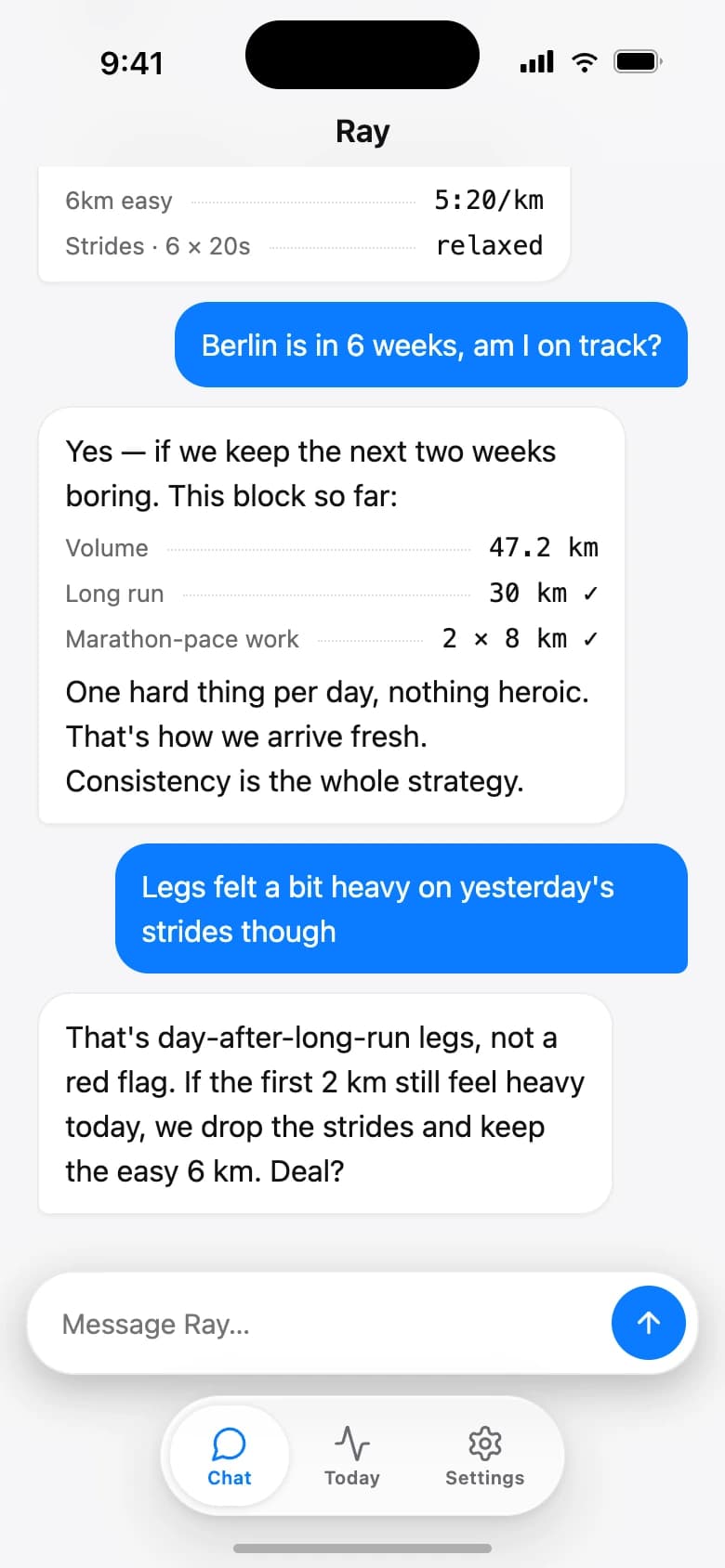
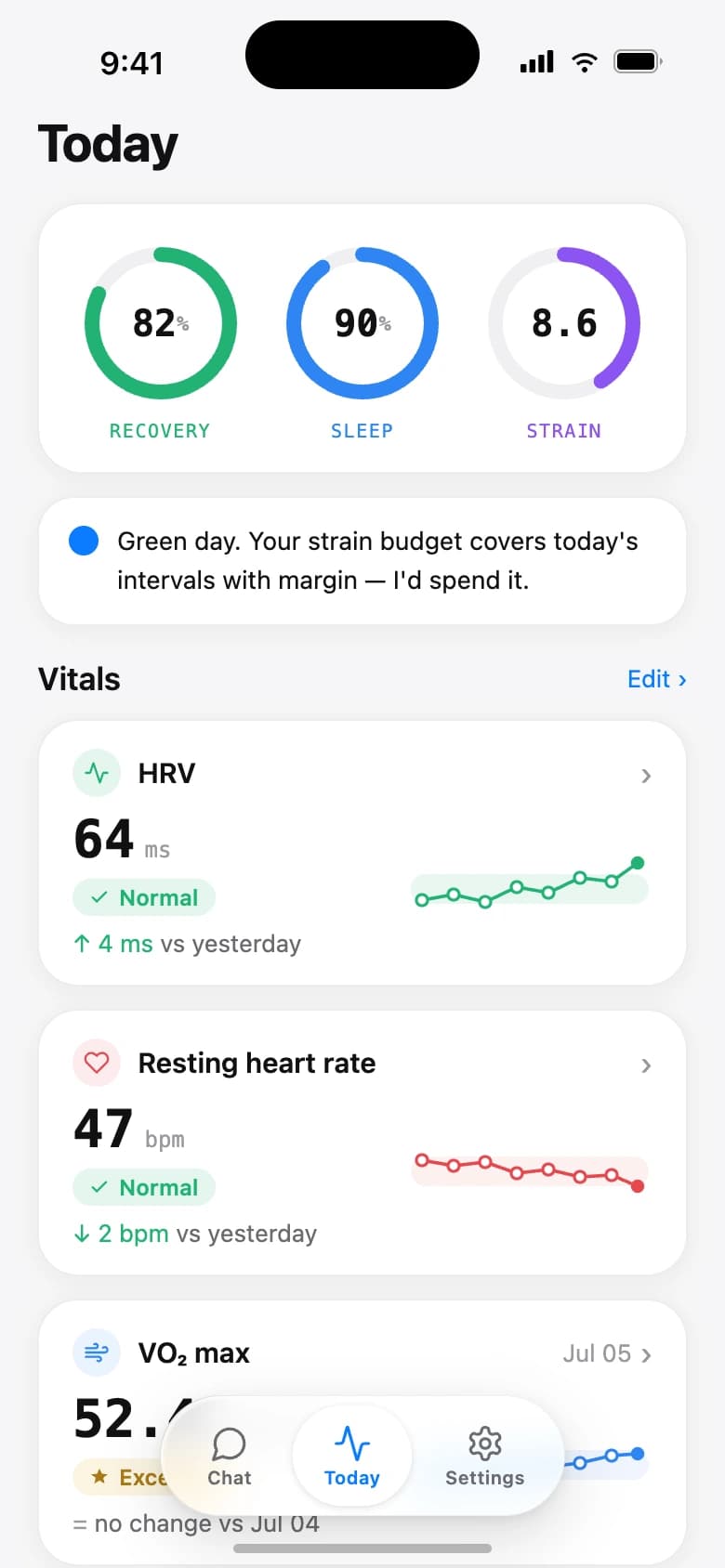
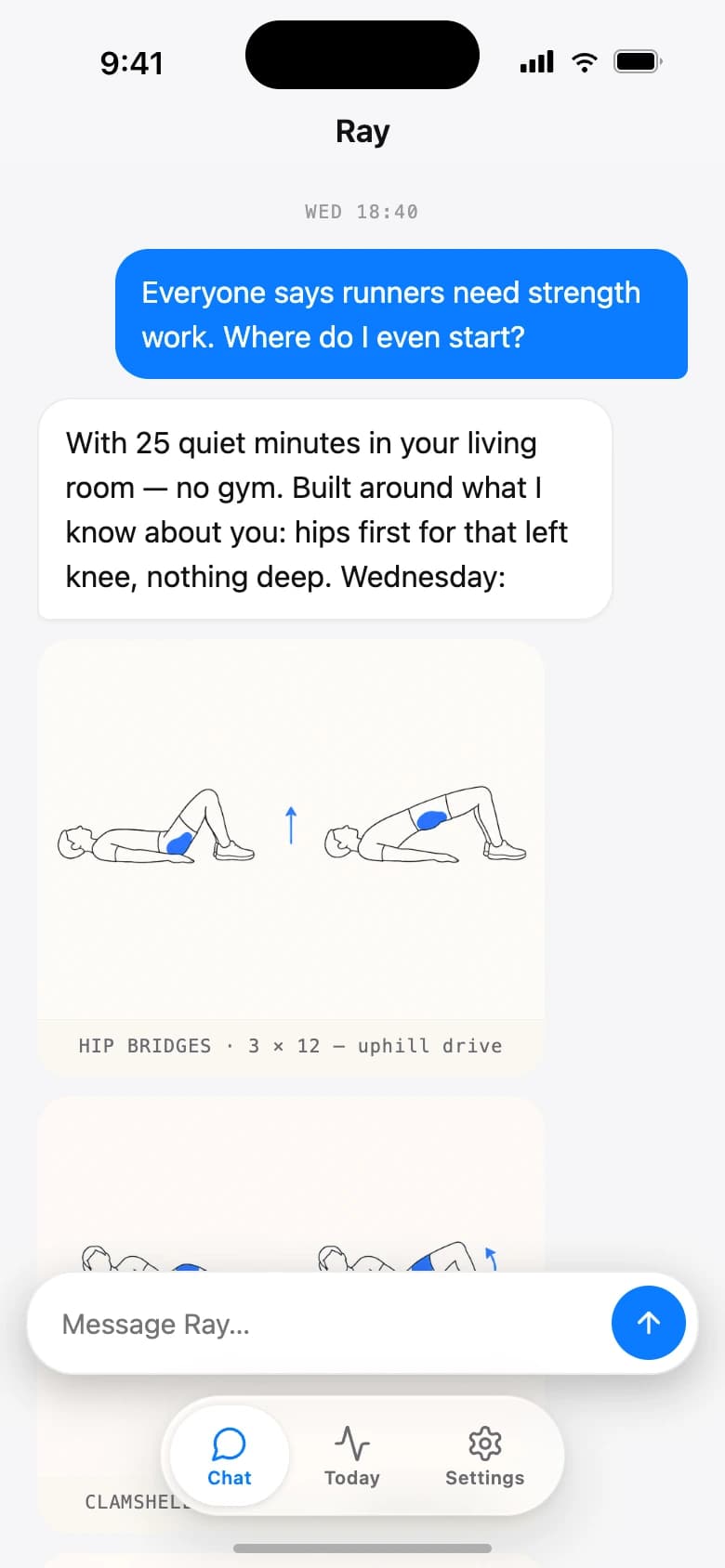
- Feels like texting a real coach: no dashboard homework or training jargon.
- Remembers goals, injuries and life context, then adjusts running and strength advice.
- Pairs a morning decision with immediate post-run feedback—and can both push and hold back.
- Currently built for iPhone and Apple Watch; other watch ecosystems are outside the current focus.
- Available through beta access rather than a broad public release.
- Runners who want dense charts and extensive manual controls may prefer a dashboard-first product.
Run With Hal — pay less, accept rougher execution
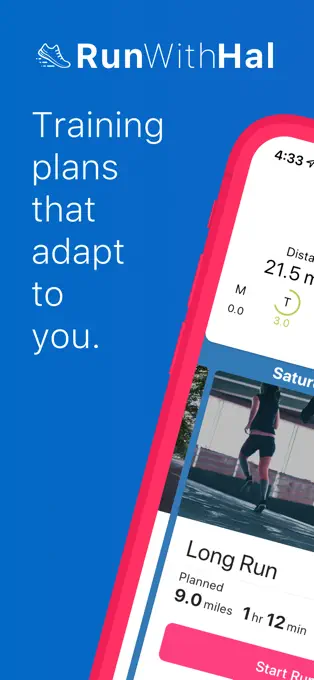
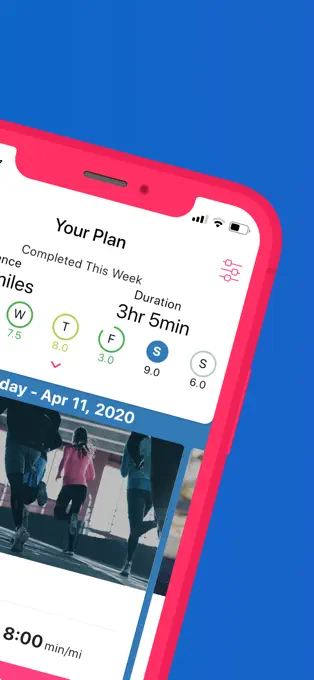
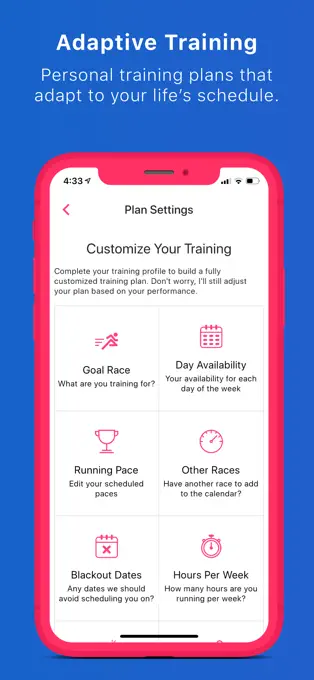
Hal Higdon's free plans have taken generations of runners to a finish line. The Run With Hal app now adds adaptive schedules from 5K to 50K, blackout dates, long-run preferences, multiple-race planning and progress tracking. That makes it more capable than the old description “a PDF in an app” suggests.
The friction goes beyond an old visual style. The information hierarchy is weak, common actions can be hard to locate, and schedule changes do not always explain themselves clearly. Instead of translating coaching expertise into one obvious next step, the app often makes the runner learn how the software is organized. That is the same underlying mismatch as Garmin: serious training knowledge, poorly surfaced.
It still gives up Runna's premium execution. Run With Hal is available on iOS and Android, but its support documentation lists Garmin as the direct device sync; Apple Watch and most other services require more manual handling. Sleep or HRV are not positioned as the daily decision engine, and the classic web plans remain self-managed. This is the pick for runners who trust conservative programming and can apply judgment themselves.
- Decades of recognizable coaching philosophy behind the plans.
- Free entry point, broad race distances and practical schedule controls.
- A calmer choice for runners who do not need constant performance pressure.
- The interface feels rough and dated, with confusing navigation and weak information hierarchy.
- Plan edits and adaptive changes can take too much work to find and understand.
- Automatic device sync is narrow, while recovery and injury context are not core inputs.
TrainAsONE — gain continuous replanning, give up simplicity
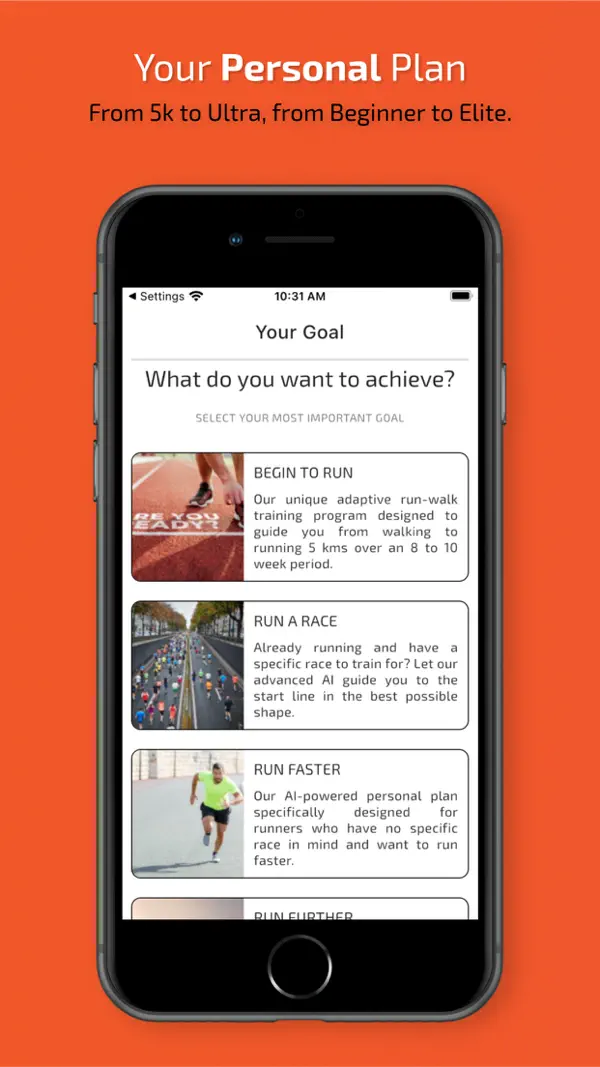
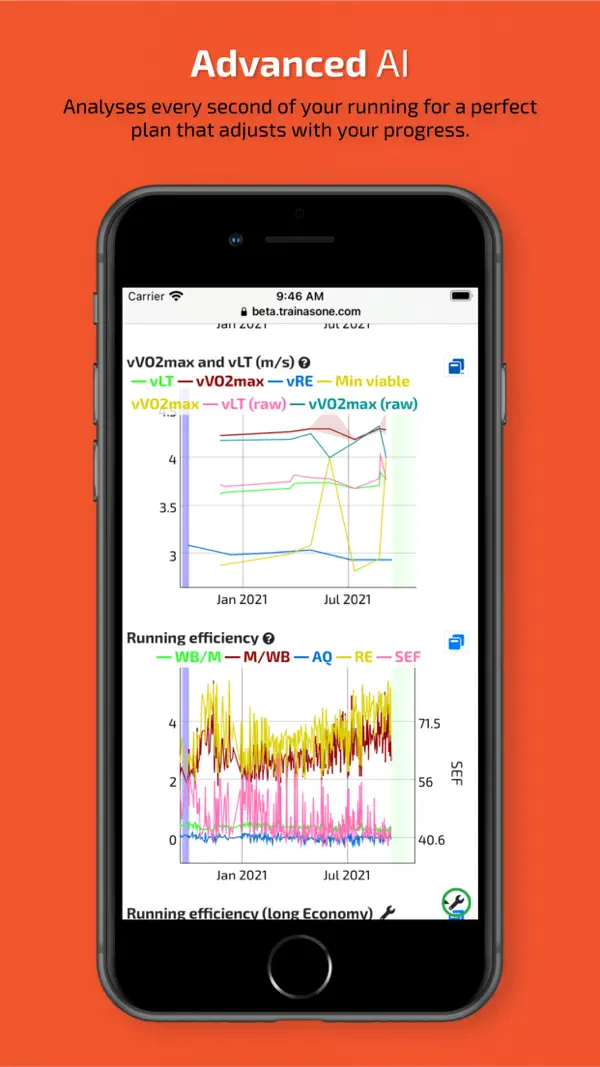
TrainAsONE has been recalculating training plans since before every fitness product used the AI label. Completed, missed and off-plan runs change what comes next; runners can set multiple goals and declare available days and session lengths. It supports a broad device ecosystem and has a genuine free tier, with Premium listed at $9.99/month in the US.
Its weakness is not the ambition of the model. It is trust and translation. The interface is utilitarian, the terminology can feel technical, and a surprising workout sequence is harder to accept when the system does not explain its reasoning in plain language. Choose it when constant replanning matters more than polish or conversation.

- Continuous plan recalculation is the product, not a decorative AI summary.
- Handles irregular availability, multiple goals and broad device support.
- The free tier is useful enough to test the system before subscribing.
- The interface and vocabulary feel technical and visually dated.
- Plan changes can be hard to trust when the explanation is thin.
- Less of the encouragement and human-readable judgment runners get from a coach.
Coopah — choose a gentler plan, accept less independent proof
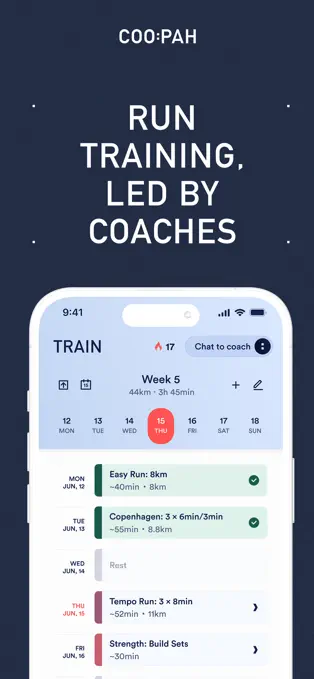
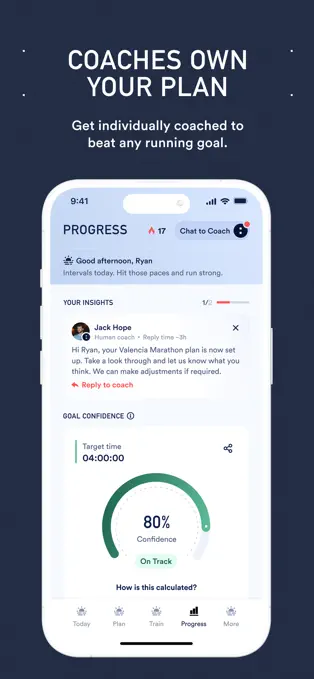
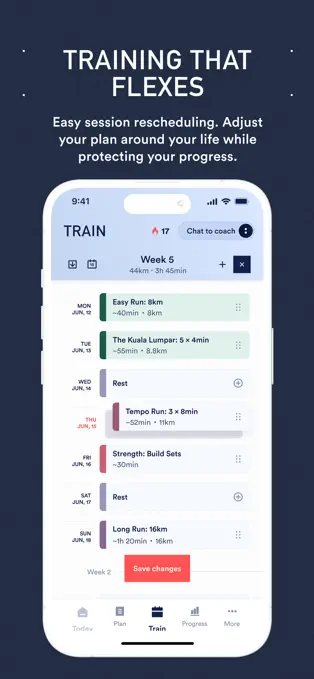
Coopah builds plans for 5K through marathon, includes strength and conditioning, syncs with Apple Watch and Garmin, and combines instant answers with access to human coaches. Its current listing describes adaptive plans, easy rescheduling and a Race Day Confidence Score. Public runner feedback often frames it as the less intense Runna alternative.
To our eyes, the current interface is more functional than polished: a conventional calendar, progress dashboard and coaching inbox, with more surfaces to navigate than one clear daily decision. That is an editorial judgment, not a user consensus—an independent review and current App Store reviews praise the layout. The stronger evidence-backed criticism is stiffness: one Reddit user found schedule moves restrictive and recalled odd sessions that did not fit their goal, while another disliked prescriptions being time-based rather than distance-based. A later commenter reported being stuck with the initially generated plan.
Those reports are version-sensitive. Coopah overhauled the product in late 2025, and a discussion of that update described check-ins and automatic adjustment as features that had been missing before. The current product now promises both. So the defensible criticism is not “Coopah never adapts”; it is that independent evidence showing how reliably the new loop repairs illness, missed training or a disrupted week is still thin.
Human response is not the weak point: users report helpful replies within hours or a day. The trade-offs are the £14.99/month subscription, a smaller public evidence base than Runna's, and nightly recovery metrics not being the centre of the daily call. Choose it for gentler plan delivery plus access to people—not yet for a proven real-time coaching loop.
- A familiar Runna-like plan experience with a generally gentler reputation.
- Strength work, watch sync and access to human coaching support.
- Clear weekly direction and useful race-readiness framing.
- The interface feels more like a functional plan dashboard than a polished coaching conversation.
- Older public reports describe restrictive rescheduling, odd sessions and plans that did not meaningfully rebuild themselves.
- The late-2025 overhaul promises automatic adaptation, but independent evidence for disrupted-week repair is still thin.
Trenara — lower the price, accept a smaller ecosystem
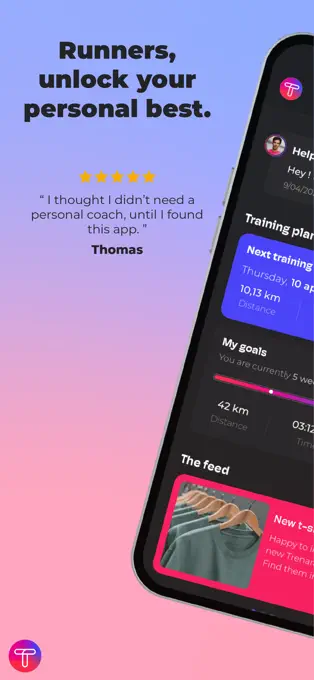
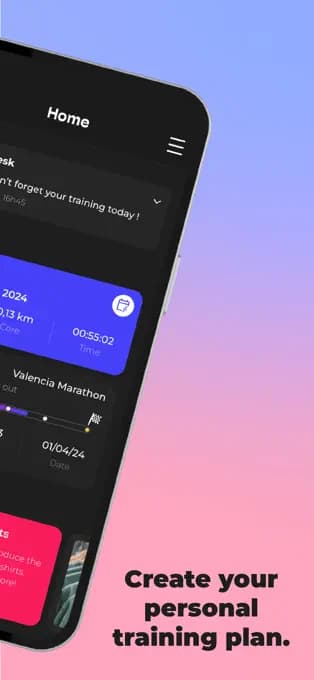
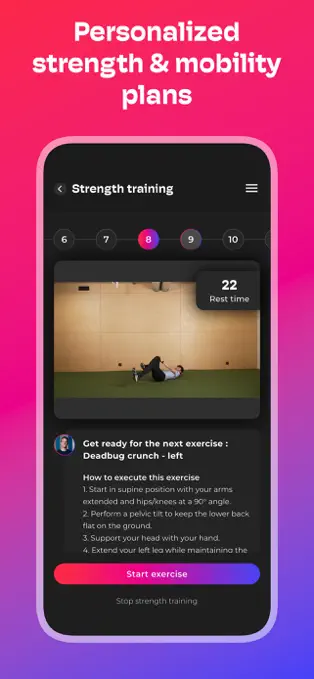
Trenara builds adaptive plans from 5K to ultramarathon using data from Garmin, Strava or Polar. It adjusts paces around physiology and training, includes race predictions and gives every runner a personalized free plan. Peak starts at $3.99/month; Peak Pro adds strength, intermediate goals, nutrition and more session controls at $9.99/month.
The smaller footprint matters. Public feedback and community troubleshooting are thinner, Apple Watch is not the centre of its integration story, and useful flexibility such as RPE-based session edits or cross-training replacements sits higher in the paid stack. A race prediction is also not a recovery decision. Trenara fits runners who want goal-focused adaptation cheaply and already train through Garmin, Strava or Polar.
- A real free personalized plan and low-cost paid tiers.
- Plans span 5K to ultra and use Garmin, Strava or Polar training data.
- Goal-time focus, race prediction and physiology-based pace updates.
- Smaller community and public evidence base than mainstream alternatives.
- Advanced edits, strength and cross-training controls require higher tiers.
- Apple Watch recovery and conversational injury context are not its focus.
Runna vs Rayvik: the actual difference
The choice is direct: Runna is a calendar-first app built to deliver a polished plan across many devices. Rayvik is a coach-first app built to make one personal decision from Apple Watch data, memory and conversation.
| QUESTION | RUNNA | RAYVIK (OURS) |
|---|---|---|
| Primary interface | A polished training calendar | Chat with an AI coach in the language you use |
| Core inputs | Goal, ability, availability and completed performance | Runs, recovery, injury history, life plans and conversation |
| Daily answer | Check the training calendar | Open Today for one quick morning decision |
| Training scope | Running plan with scheduled strength sessions | Running and strength advice inside the same conversation |
| After a workout | Review the activity and plan progress | Get immediate conversational feedback while the session is fresh |
| When fitness improves | Updates paces and goals | Updates only after the evidence is strong enough, then explains why |
| After poor sleep or a niggle | The runner manages the plan and schedule | Designed to reduce or replace the day when several signals support it |
| Device support | Apple Watch, Garmin, COROS, Suunto, Fitbit and more | iPhone + Apple Watch |
| Availability | Public subscription | Free beta access |
Switch only when the trade is worth it
- Runna is working and the price is acceptable. Stay. Switching creates setup cost and does not guarantee better training.
- You only need free structure and motivation. Move to Nike Run Club, knowing that you will repair disrupted weeks yourself.
- You want existing Garmin data to drive the plan. Move to Garmin Run Coach if your watch is compatible and you accept the ecosystem lock-in.
- You want nightly recovery and life context in the decision. Move to Rayvik if you use iPhone and Apple Watch and can give up Runna's wider device support.
- You want stronger automatic replanning. Try TrainAsONE if a more technical interface is an acceptable price for the deeper algorithmic loop.
- You want a gentler plan with human support. Try Coopah, while treating its newer adaptive behavior as less proven than Runna's mature product.
Runna alternative FAQs
What is the best free alternative to Runna?
Nike Run Club is the best free starting point for guided audio runs and straightforward plans. Garmin Run Coach is the stronger adaptive value if you already own a compatible Garmin. Run With Hal has free plan access, and Rayvik is free while in beta for iPhone and Apple Watch runners.
Which Runna alternative adapts when I miss a workout?
Garmin Run Coach, TrainAsONE, Run With Hal and Trenara all describe adaptive plan behavior, although the depth and explanation differ. Test a disrupted week before committing: missing one workout should rebalance the week rather than stack hard sessions together.
Which Runna alternative uses sleep and recovery data?
Garmin Run Coach can use sleep, recovery, stress and training-load information on compatible watches. Rayvik is designed around Apple Watch runs plus sleep, HRV, resting heart rate, injury context and conversation. Product support varies by device, and recovery data should inform—not automatically overrule—the runner.
Can I use Runna without paying?
Runna offers a 7-day Premium trial. Without Premium, users can access the first week of a plan and basic features such as recording runs and importing activities, but full personalized plans require a subscription. If cost is the main issue, Nike Run Club, Garmin Run Coach and classic Hal Higdon plans are more complete free starting points.
Why do runners leave Runna?
The recurring reasons are price, training that feels too intense for the runner's current recovery, and wanting a plan that responds more clearly to missed weeks, poor sleep, pain signals or an unpredictable schedule. Other runners stay precisely because Runna pushes them and makes structured training easy to follow.
Is Runna worth it?
Yes for runners who want a mature, polished race plan with broad watch support and clear workout execution. It is less compelling when the main problem is day-to-day recovery, injury context or needing a coach-like conversation rather than another training calendar.
Sources & notes
We build Rayvik, which is included in this comparison. Product details were checked against official sources on August 7, 2026. We use no affiliate links.
References: Runna pricing, Runna subscription support, Nike Run Club, Garmin Run Coach, Run With Hal, TrainAsONE, Coopah and Trenara. Corrections: hey@rayvik.app.
Keep reading
Runna, Nike Run Club, Garmin, Run With Hal, TrainAsONE, Coopah and Trenara are trademarks of their respective owners. Rayvik is independent and is not affiliated with or endorsed by them. Product icons and store previews are shown for identification and comparison.