ChatGPT as a running coach: where it works, where it breaks
Plenty of runners are training off a chatbot plan right now, and some are doing fine. This is the honest map of when that goes well, when it quietly goes wrong, and what the peer-reviewed evidence actually says. It applies to Claude and Gemini just as much, including the models that power our own app.
Where ChatGPT is genuinely good
Let's start with the credit, because it's real. As a running encyclopedia, ChatGPT is better than most of what you'll find by searching: it explains lactate threshold, supercompensation and 80/20 intensity distribution clearly, patiently, and at whatever depth you ask for.
- Decoding jargon. “What does 6×800m at 5K pace actually mean?” Perfect use.
- One-off questions. Fueling for a 90-minute long run, what to do the week after a half marathon, how to come back from a cold. Good, mainstream answers.
- Reformatting. Turning a plan you already trust into a weekly calendar, or adapting session wording for a treadmill. Mechanical, and it nails it.
- A sounding board. Thinking out loud about goals and trade-offs, as long as you remember it will mostly agree with you (more on that below).
What the research found
This isn't just vibes. A peer-reviewed study in the Journal of Sports Science and Medicine (2024) had coaching experts evaluate three six-week plans generated by the version of ChatGPT available for that experiment. The headline finding is in the paper's own title: the plans were not rated optimal. Quality improved when prompts included more information about the runner, but even the most detailed prompt did not produce a plan the experts rated optimal. That is useful evidence about prompt quality and the model tested, not a verdict on every current chatbot or coaching product.
Note what that study measured: the plan on day zero, the thing chatbots are best at. Coaching mostly isn't writing the plan. It's the six weeks that follow, and that's where the structural problems live.
The four ways it breaks as a coach
- 01It can't see you. ChatGPT has no feed of your runs, sleep, HRV or resting heart rate. It doesn't know your last three easy runs drifted 20 seconds per km slower at the same heart rate, the classic early-overreaching signature. You'd have to notice that yourself and paste it in; the runners who most need a coach are precisely the ones who don't notice.
- 02It doesn't reliably remember. Chat memory features are shallow and easy to silently lose. The calf niggle you mentioned three weeks ago is not in the room when this week's plan gets written. That's the exact opposite of what makes a coach worth having.
- 03It agrees with you. Propose adding a second interval session to an already-hard week and you'll usually get an enthusiastic yes with a plan attached. Chatbots are trained to be helpful, and in training, unconditional helpfulness is a hazard: the most valuable coaching sentence is no, not today, said unprompted.
- 04It states numbers with unearned confidence. Paces, mileage jumps and race predictions come out fluent and specific whether they're grounded or not. A 10% weekly mileage rule applied to your bad ankle history is not a pace table problem. It's a judgment problem, and fluency hides the difference.
None of this is a dig at any one model. Claude and Gemini share versions of all four risks, and Rayvik itself is built on this class of models. The point is architectural: a standalone chat does not, by default, have a reliable live training-data feed, a durable athlete record or training-specific safety policies. Coaching needs those pieces around the model.
The gap cost me an hour in my first marathon
The equivalence calculation was not absurd; my half-marathon speed really did point toward a faster marathon under sufficient preparation. The failure was treating that ceiling as a supported race plan without checking weekly volume, long-run durability, strength, fuelling or conditions. That experience is why our free marathon time predictor keeps the formulas visible, then adjusts the planning range against the training evidence they cannot see.
If you use it anyway: do it like this
Chatbot coaching costs nothing to try (the health-data connectors are another story, and paid), and used carefully it beats no structure at all:
- Front-load your context every time: age, weekly mileage, recent race times, injury history, available days. The JSSM study found more input measurably improves plan quality.
- Ask it to argue against you. “What's the strongest case that this plan is too aggressive for me?” cuts through the agreeableness better than asking for approval.
- Keep a canonical training log elsewhere and paste the last two weeks in before any plan revision. You are the data feed now, so be a good one.
- Never take a pace target from a chatbot into a hard session without sanity-checking it against a recent race result. If they disagree, trust the race.
If that list feels like a part-time job, that's the honest summary. You can be the eyes, memory and brakes for a free chatbot, or you can use a system where those are built in. That's the actual dividing line in the AI running coach category, and it's worth understanding before you pay for anything (or before you shop the app alternatives).
What changes when the coach carries the context
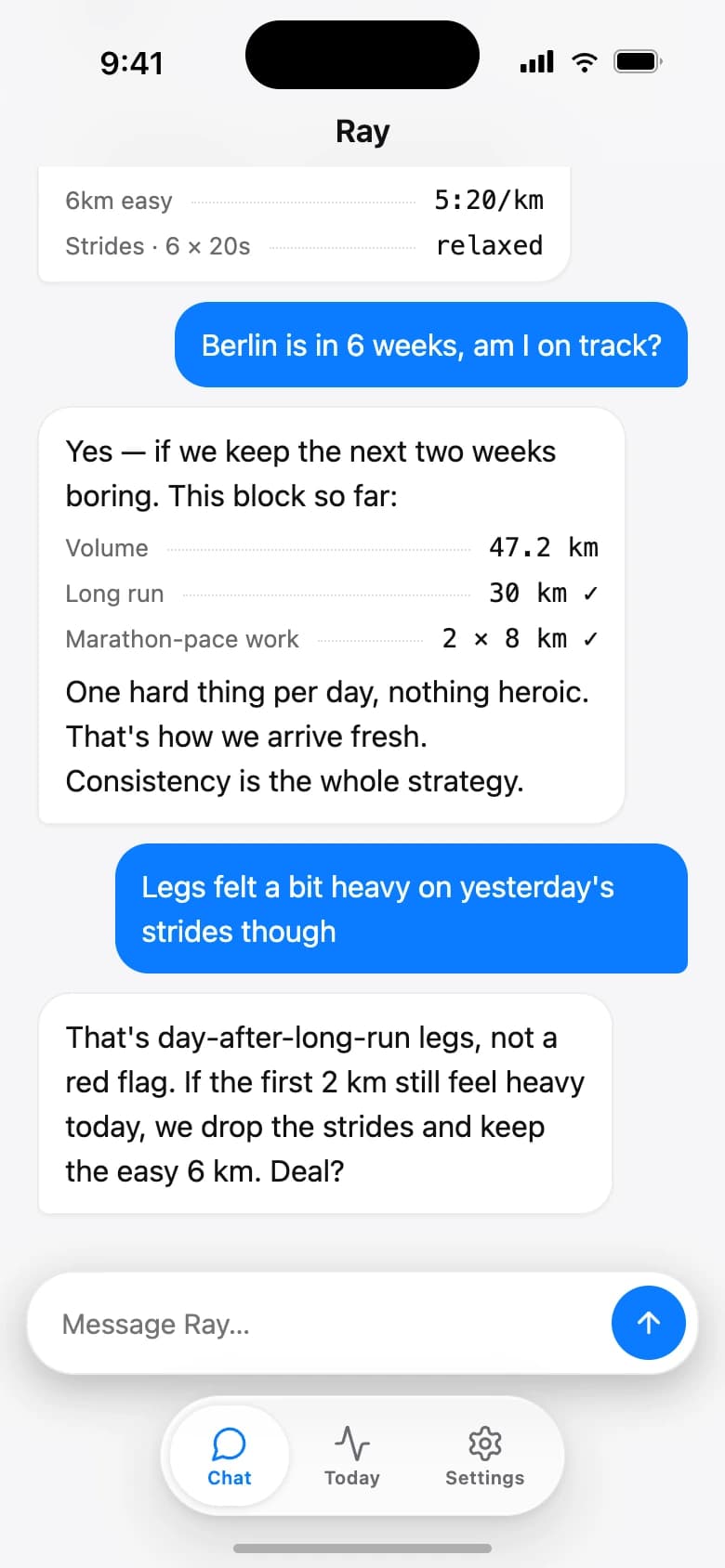
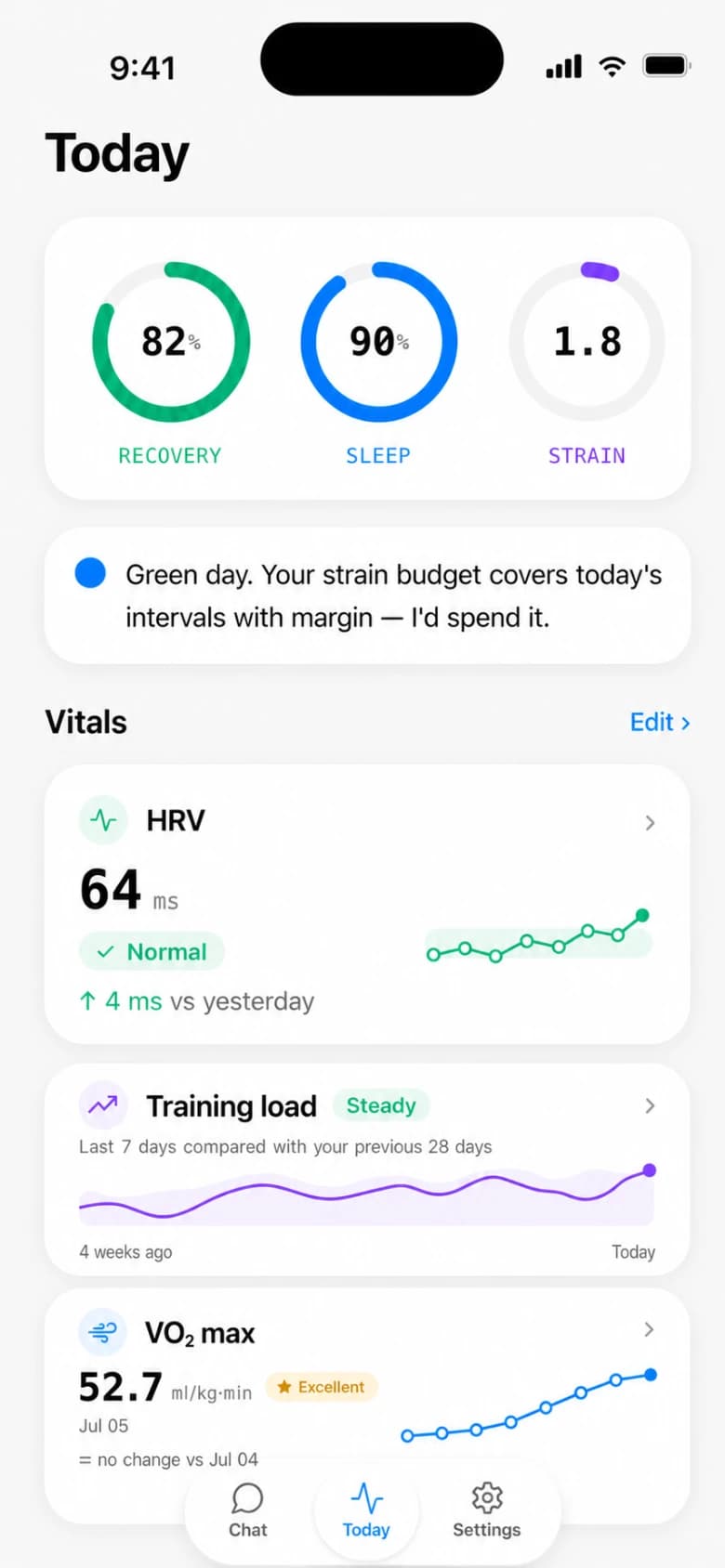
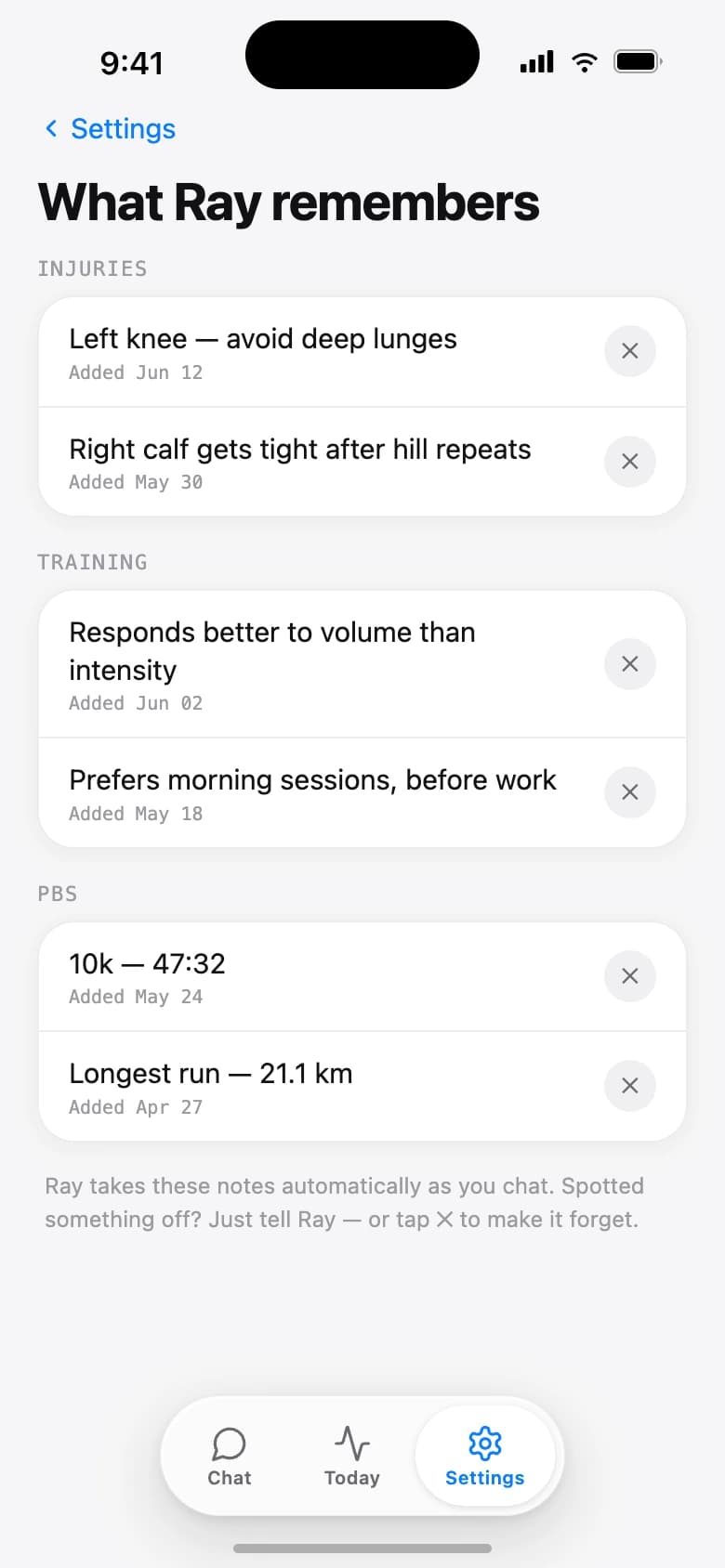
Rayvik uses the same broad class of AI, so the model itself is not the magic difference. The difference is the coaching system around it: you can talk naturally, let Today put recent training load beside recovery, and keep injuries, goals and preferences available to future decisions. You are no longer rebuilding the athlete from screenshots before the useful conversation can begin.
- Conversation becomes the interface. Say that your calf feels tight or work disrupted the week; get a clear keep, reduce or replace decision in plain language.
- Today turns signals into one call. Recent running and strength load sit beside sleep, HRV and your own feedback, so the answer is about today's session—not another recovery score.
- Memory stays in the coaching loop. Injury history, race goals, training preferences and the way you respond to sessions remain available when the next week is adjusted.
ChatGPT running coach FAQs
Can you use ChatGPT as a running coach?
You can, and for one-off questions it's genuinely useful. As an ongoing coach, a standalone chat does not automatically receive your training data or maintain a dependable athlete record. In a 2024 study, coaching experts did not rate three ChatGPT-generated plans optimal, although more detailed prompts improved them.
Does ChatGPT give good running advice?
On general principles (what threshold pace is, why easy runs matter, how to structure a taper), yes, usually. The risk isn't the concepts, it's the specifics: paces and weekly structures are generated confidently whether or not they fit you, and the plan doesn't change when your recovery does.
Which AI is best as a running coach?
ChatGPT, Claude and Gemini differ in model behavior, context handling and available integrations. For coaching, the larger practical question is whether the product around the model has a dependable training-data feed, durable athlete history and training-specific guardrails. A standalone chat generally requires you to supply and maintain that context yourself.
Is Claude better than ChatGPT for running plans?
There are real differences, and some runners find Claude effective for keeping a long, structured planning conversation coherent. But model choice alone does not create a coaching system: without a connected data workflow, you still need to provide runs, sleep, heart-rate data and relevant history. Either can help with learning and planning; hard-session pacing still deserves an independent sanity check.
Is there research on ChatGPT training plans?
Yes. A 2024 peer-reviewed study in the Journal of Sports Science and Medicine had coaching experts evaluate ChatGPT-generated plans for recreational runners. The plans were not rated optimal, though ratings improved when the prompts included more information about the runner. That's evidence for both the ceiling and the 'better prompts help' folk wisdom.
How is Rayvik different from using ChatGPT as a running coach?
Rayvik is built around the coaching context a standalone chat makes you maintain manually. It can put Apple Watch runs and recovery beside your goal, injury history, schedule and feedback, then turn that context into one daily training decision. It still uses AI, but the runner does not have to rebuild the full story for every question.