Marathon Recovery Plan and When to Run Again
You trained for months. Now the marathon is over, and you’re wondering how much time you can take off before you start losing the fitness you worked for.Or you’ve already tried an easy run, and it felt nothing like easy.

A runner on Reddit described that second feeling. Happy with their first marathon, then miserable on the short runs afterward. Slower pace, higher heart rate, and friends from the same race already running normally. They wondered whether they were starting over.
I’d want more than “listen to your body” at that point. What goes on the calendar this week? What comes off it if a short run feels awful? That’s what I’ve put together here, starting with today and the common mistakes, then working back toward regular training.
And yes, there’s the next race. Late in a marathon, you’re thinking, why did I pay to do this? The next day you’re looking up when entries open, still taking the stairs one at a time.
I’ve been watching NYC Marathon clips this week. There was the pregnant runner out on the course, and the clip of runners stopping to help someone near the finish. I kept watching those. But I also know a runner who raced three or four times in a month when things were going well. They got injured later and couldn’t run for three months. I want the recovery weeks on the calendar before another race fills them.
A marathon recovery timeline
Some of this comes from my own running, and some from talking to runners who’ve been doing it much longer than I have at local club runs. I checked the advice on when to start running again separately. If the stairs still hurt, I’d wait before going for a run.
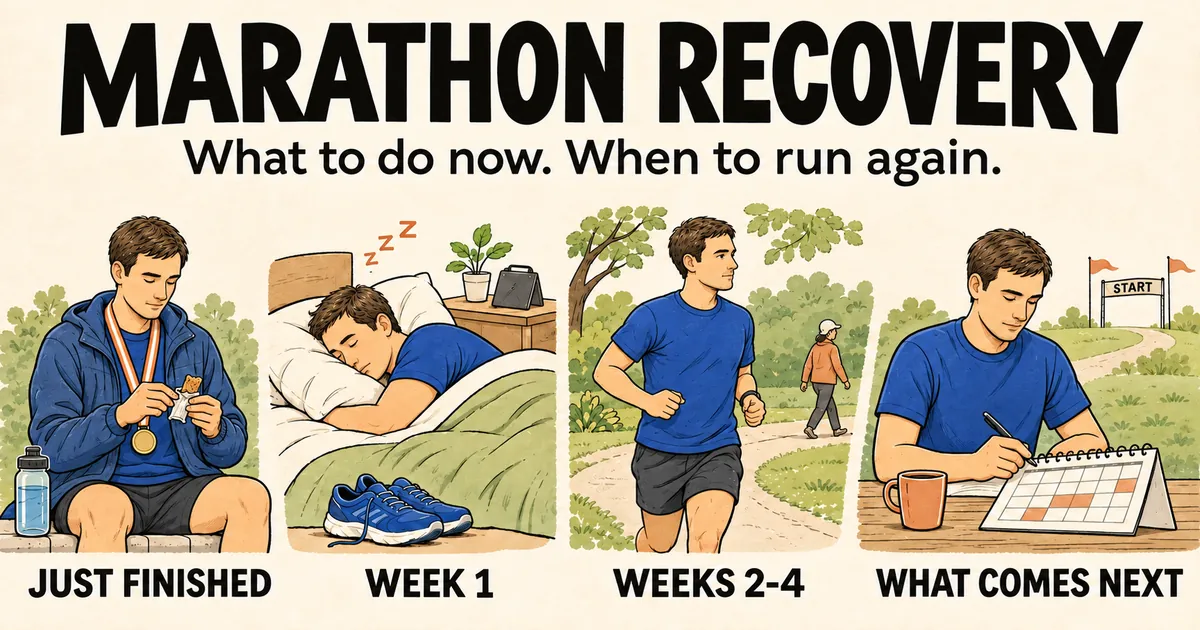
| STAGE | DO FIRST | COMMON MISTAKE |
|---|---|---|
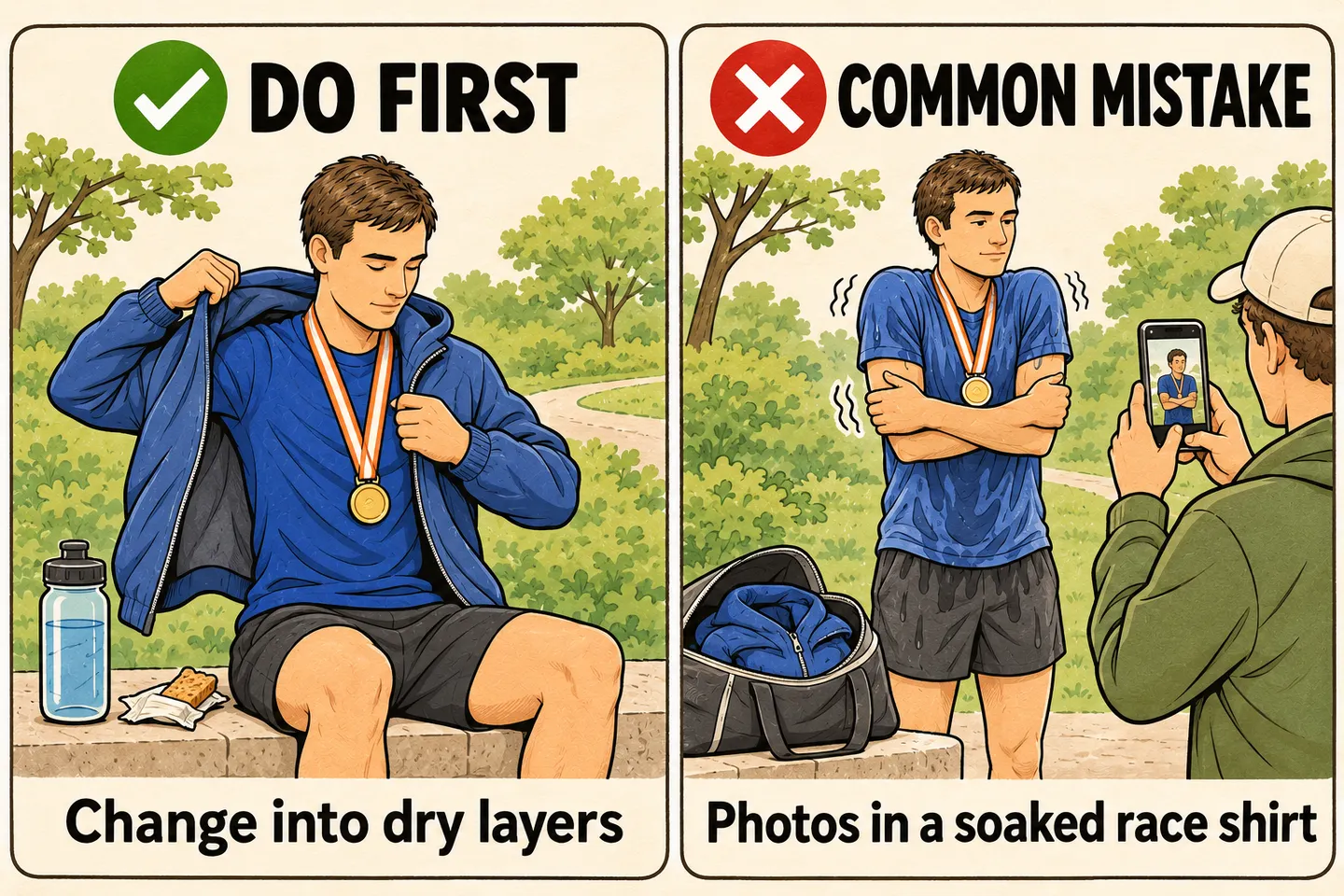
| Just finished | Get dry and warm, eat something tolerable, and replace fluids gradually. Keep movement gentle if you feel well. | Standing around for photos in a sweat-soaked race shirt. |
| Days 1–7 | Prioritize sleep, meals and time away from running and strenuous training. Keep ordinary movement comfortable. | Treating an easy walk like a step target, or forcing a test run. |
| Weeks 2–4 | Reintroduce short, easy running when appropriate. Build frequency, then volume, then intensity as the response allows. | Trying to fit the missed workouts into the next few days. |
| After week 4 | Review how the recent weeks went, then plan maintenance, a new block or a changed race goal. | Going straight back to hard training because four weeks have passed. |
For the timing, see HSS’s recovery advice, Yale Medicine and HSS’s guide to building back gradually.
Just finished the marathon
Get dry, get warm, and have something you can eat
Put a dry top where you can get to it without digging through your whole bag. Change before you stand around for medal photos, especially if it’s cool out. A parent on RunNYC asked what to bring for their son after his first marathon. The replies had the right idea. Dry layers, different shoes, a snack he already likes, and somewhere to sit.
HSS recommends dry clothes and food with carbs and protein. A familiar snack is useful if a big meal sounds awful right after the race. Sip and replace fluids gradually. London Marathon’s medical team warns against overdrinking.
A little walking is enough
If you feel well, keep moving gently through the finish area, as HSS advises. Once you’re out of the finish area, there’s no mileage target to hit. If you feel unwell, get help rather than trying to walk it off.
You don’t need to stretch to prevent soreness
The Cochrane review of stretching and post-exercise soreness found no clinically important reduction in delayed-onset muscle soreness from stretching before or after exercise. I wouldn’t stand around at the finish doing stretches just to prevent tomorrow’s aches.
Is an ice bath worth it?
Cold water immersion is optional here. A systematic review of exercise-recovery trials found benefits for soreness and perceived recovery in some settings. A placebo-controlled marathon study did not show better functional recovery from cryotherapy than placebo. Feeling less sore and having restored your capacity to train are different outcomes.
If an ice bath makes you feel better, fine. I wouldn’t use that feeling to move the next run forward.
Week 1 after a marathon
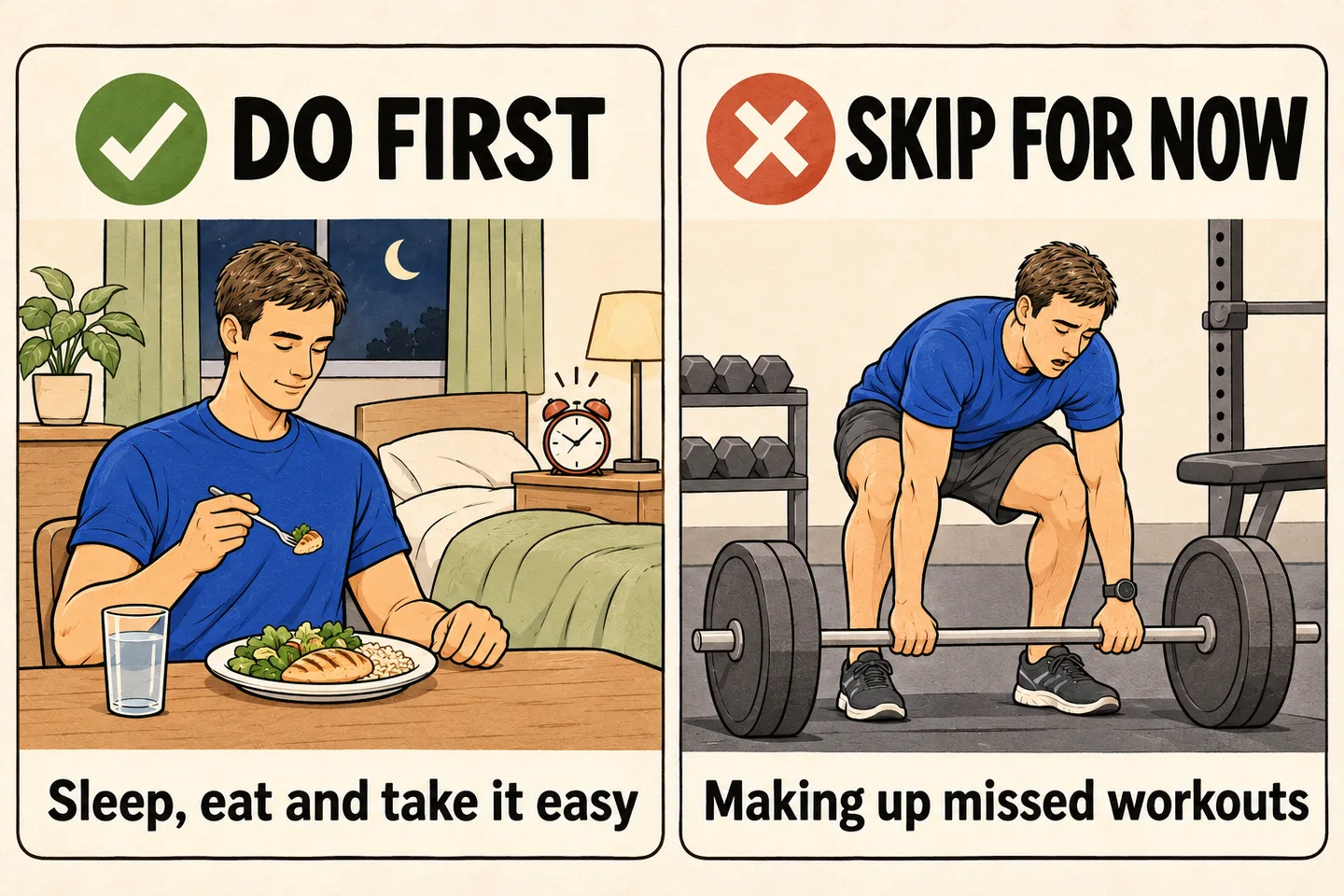
After a hard marathon, I’d start by giving myself a week off running. Go for a short walk if it feels good. Leave the hard bike ride or gym session for another week.
Give sleep and meals a place in the calendar
In a RunNYC discussion about post-race sleep, runners described being exhausted but unable to stay asleep or get comfortable.
If the early alarm was only there for a run, turn it off if you can. Yale’s advice is to use some of that time to sleep. Keep eating regular meals even though you’re running less.
Comfortable movement, without collecting steps
In a Reddit recovery-routine thread, one runner credited a long post-race walk with feeling better quickly. A reply described a similar day followed by severe hip discomfort. I would take the idea of gentle movement from that conversation, without adopting someone else’s mileage.
Use familiar activities and keep them easy. Yale cautions against taking up a new workout immediately after a marathon. It also advises waiting a couple of days for a sports massage and returning carefully to strength work.
Will I lose fitness while I rest?
Some fitness measures can fall when training stops. A study of 15 endurance-trained men found lower VO₂max after two weeks off, while muscle endurance was maintained. But that study wasn’t about recovering from a marathon. In a separate study of 11 recreational marathon runners, several aerobic and running-performance measures showed little change from before the race when tested seven days afterward. That small study doesn’t establish when everyone can run again. It does give me a reason to question the feeling that a difficult first week means the whole training block has gone.
I can’t give you a number of days that guarantees zero loss. I’d aim to get back to a running week I can repeat. Start with time off, then short easy outings when appropriate, then rebuild the week. The reverse-taper approach puts frequency before mileage and leaves intensity until later. I wouldn’t put intervals back in just to stop a fitness score falling.
For the first runs, I’d record the minutes, how hard the effort felt and what the following morning was like. That gives me something to change next time. A slower pace on one outing can’t tell me how much fitness I’ve lost. Below, I’ve set out what I’d repeat, reduce or build on, along with the numbers I’d check over several days.
How long before the first run?
Yale Medicine describes five to seven days off running as common advice, followed by short, easy runs. A more conservative 2020 NYRR article by an HSS physical therapist recommends waiting three to four weeks. That’s a big gap. I’d use the earlier date to check in with how I feel, without putting a run on the calendar in advance.
Can you walk and take the stairs comfortably? How tired are you? If everyday movement is still hard, give it more time and get advice as needed. When you do go out, keep it short and easy.
Look after yourself without assuming an “immune crash”
The link between strenuous exercise and infection is more complicated than a fixed period of immune suppression. A review of exercise and immune function challenges that interpretation. An IOC subgroup’s review of respiratory-illness risks also considers factors such as travel, crowding and increased training stress.
My practical takeaway is to protect sleep, eat enough and reduce avoidable exposure to illness during a demanding week. If you become ill, pause the return-to-training decision and seek advice as needed. I wouldn’t tell every marathon finisher that their immune system is necessarily weakened for a set number of days.
Weeks 2–4 after a marathon
Getting through a short run is a good start. I’d give myself a chance to repeat it before I started adding distance or thinking about intervals.
I like the order in HSS’s explanation of a reverse taper. Get used to running on a few days again, then build mileage. Save the fast work for later.
Keep the early runs short and easy
Yale recommends keeping the first runs short and easy. Before going out, choose a short duration and give yourself permission to finish early. I’d leave the old pace target off the screen and note the effort instead.
What I’d do with the next running slot
- Easy during the run, no setback afterward
Repeat the same short duration at the next outing before making it longer. Keep rest between early outings; one comfortable run isn’t a reason to restore the old week.
- Harder than expected, or worse the next morning
Replace the next run with rest or comfortable walking. Don’t add its minutes to a later run. If pain persists, worsens or changes how you move, get it assessed.
- Several easy outings have settled
Rebuild a manageable routine, then add duration gradually. Keep the fast sessions out until easy training is going well. Review the recent trend in sleep, readings and run feedback before adding more.
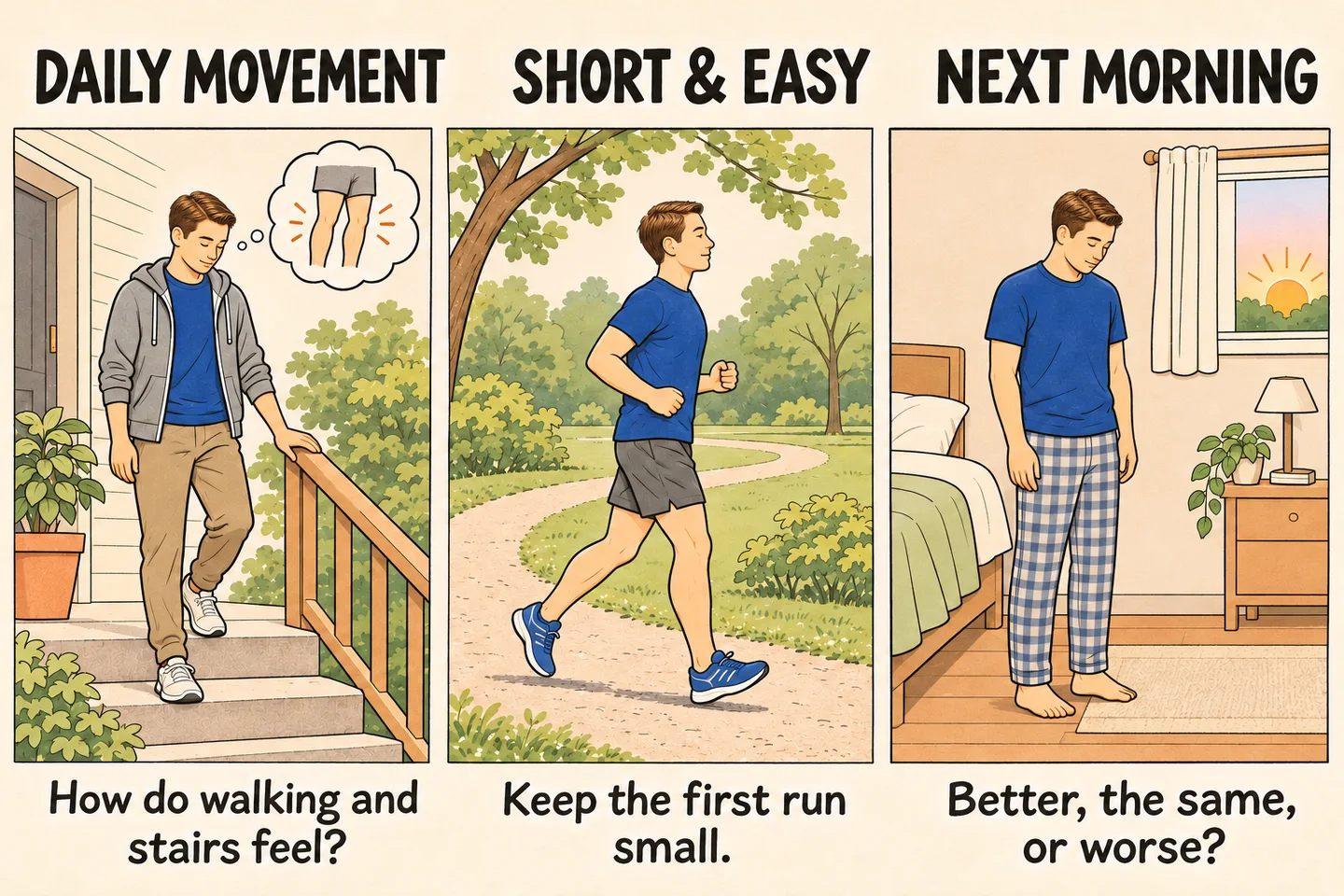
If you swap Thursday’s run for a walk, leave Thursday there. You don’t have to squeeze the missed miles into Saturday.
Persistent or worsening pain, or discomfort that changes how you move, deserves professional assessment. Chest pain, fainting or confusion needs urgent medical attention. A recovery schedule is not a way to work through those symptoms.
After week 4, what comes next?
Around week four, I’d look back at the easy runs I’ve managed. How did they feel the next morning? Could I repeat that week comfortably? If I’m still struggling with those runs, I’d give myself longer before starting a new training block.
Then there’s the race you’ve already entered. NYRR’s coaches have a good answer for anyone eyeing a second marathon a month later to make up for a disappointing finish. Give yourself time to recover and build again. If I already had a bib, I’d ask whether I could be happy taking it easy, or whether I’d spend the whole race chasing the time I missed. I’d also leave myself the option of staying home.
The numbers I’d check before adding more
It’s tempting to compare notes with the person from your club who was back out three days later. I’d rather compare this week with my own usual pattern. That means several recent readings, taken in a comparable way, alongside sleep and how the easy outings went. A review of HRV-guided running research emphasizes individual baselines and consistent measurements. It doesn’t give us a universal post-marathon HRV target.
In Rayvik, I’d open Today. Recovery, Sleep and Strain give me a quick overview, with HRV, heart-rate readings, VO₂max and Training load below when the data is available. Here’s how I’d read that screen during a recovery week.
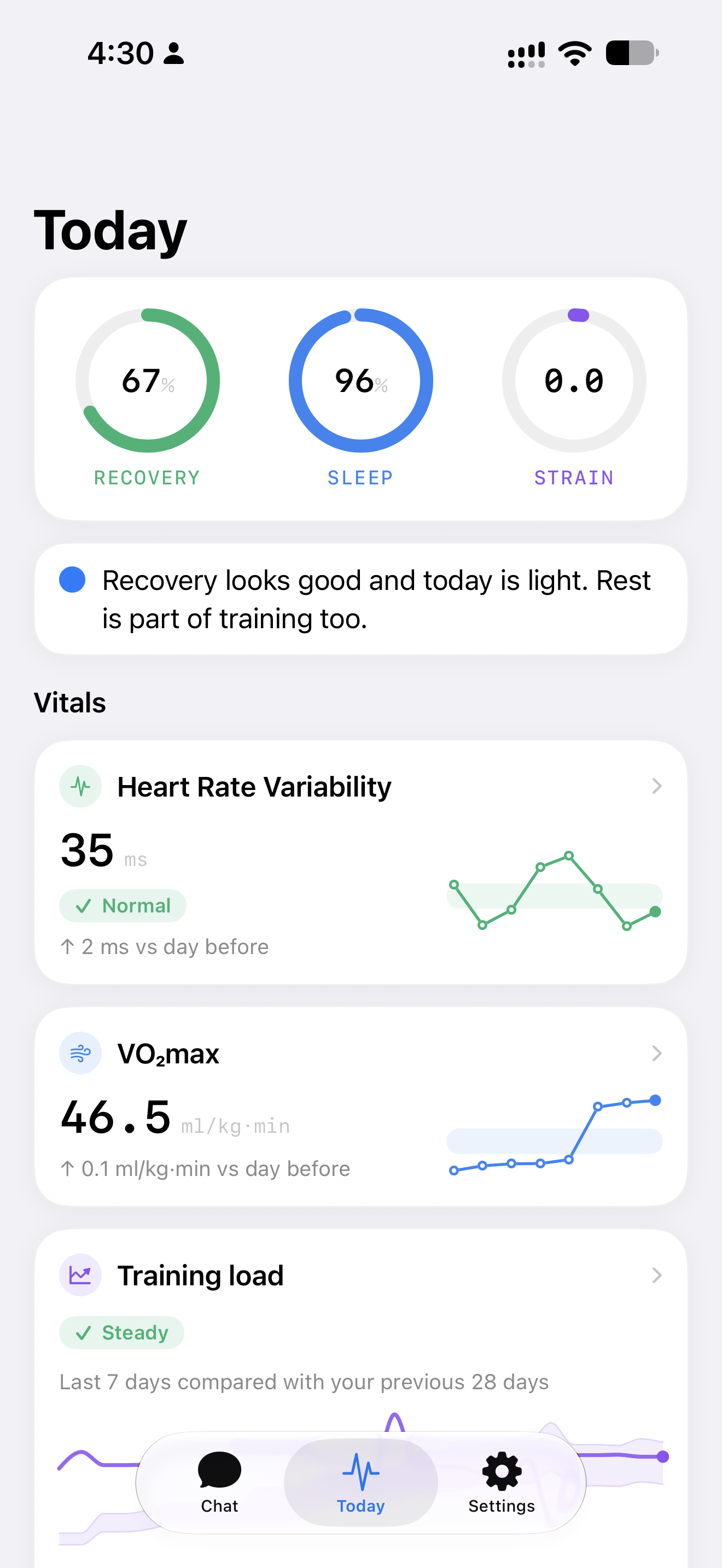
Three scores, three different questions
Recovery 67% is Rayvik’s estimate from available recovery signals. It doesn’t mean muscles are 67% healed. I’d check how it compares with recent days and look at the readings underneath.
Sleep 96% describes the recorded main sleep. I’d also look at its duration and whether the last few nights have been close to my usual. One high Sleep score doesn’t settle the running decision.
Strain 0.0 is the exercise load recorded for that day so far, on a 0–21 scale. It isn’t a ring I need to fill. Recovery and Sleep use a 0–100 scale.
Check which date a reading covers and whether the latest data is available before comparing it. A missing reading is a gap, not a good or bad result.
What I’d compare with my own usual
| READING | WHAT I’D LOOK FOR | HOW I’D USE IT |
|---|---|---|
| HRV | Several comparable readings versus my usual pre-race range. The 35 ms shown above isn’t a target for another runner. | If it stays unusual, check the rest of the picture before increasing training. Don’t chase a higher number with a workout. |
| Resting or sleeping heart rate | Whether the same type of reading is moving back toward my usual range. Keep resting and sleeping measurements separate. | Note a sustained change alongside sleep, symptoms and recent activity. A return to usual supports the review, rather than approving a hard run. |
| Sleep | Duration and how several nights compare with my usual, as well as the score. | If sleep is still poor and the easy outings feel rough, keep the next session modest or replace it. Make room for sleep before adding load. |
| Strain and Training load | Today’s recorded exercise and the recent load trend. Training load compares the last 7 days with the previous 28. | Expect the running load to come down during recovery. A lighter week is deliberate; don’t add miles just to keep the chart up. |
| VO₂max | The available estimate and its longer pattern, including the date of the latest reading. | Don’t use a single change to calculate fitness lost since the marathon or decide that intervals need to return. |
Suppose the recent numbers look closer to your usual and short easy runs also feel comfortable afterward. I’d repeat the manageable running first, then build gradually. If the score looks good but the next morning brings sore stairs, I’d take the run back out. If I feel fine but several readings remain unusual, I’d check the dates and measurement conditions, note travel, sleep or illness, and hold off adding intensity while reviewing it.
I’d take that whole picture to the coach. The readings help explain the week; they don’t diagnose why a number changed or show whether an injured area has healed. The useful outcome is a decision about the next session, with a record of why it changed.
My recovery week
Write down what you planned and how it felt the next morning.
- Race and date
- How hard the race felt
- Walking, stairs and any discomfort
- Sleep, energy and trends versus my usual
Note the activity, how the next morning felt, and whether your recent readings are close to your usual range. Then mark the next session as repeat, reduce or progress.
Putting a recovery plan into practice
Would Rayvik still leave the weekend run off the calendar if there was another marathon coming up? I tried it with a test account. I gave the runner a 4:02:58 New York finish, sore legs, and a CIM bib.
I asked if an easy run that weekend was too soon. Avery said to skip it, then put together a week around Tuesday, Thursday and the weekend.
I made up the race and health data for this test. The screenshots show the conversation and the plan Rayvik saved.
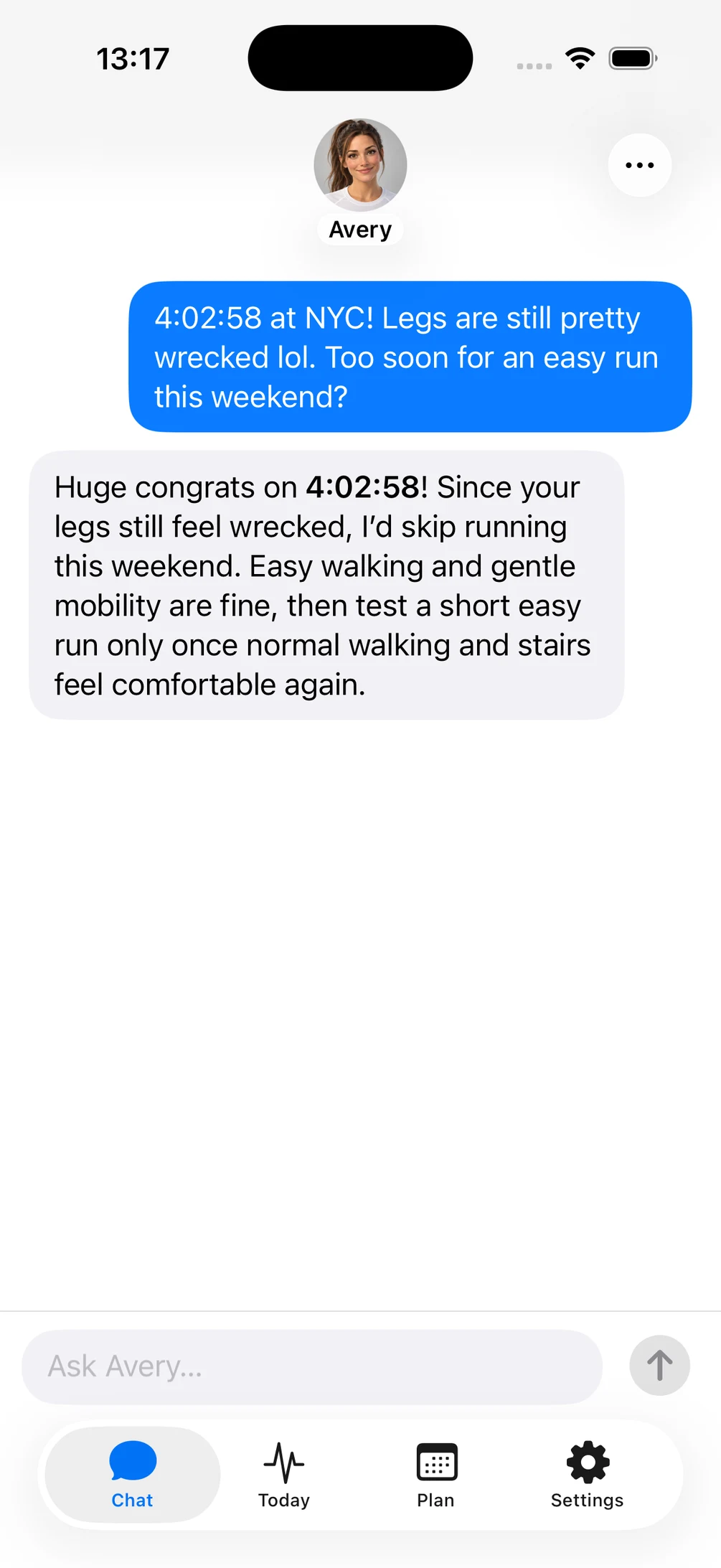
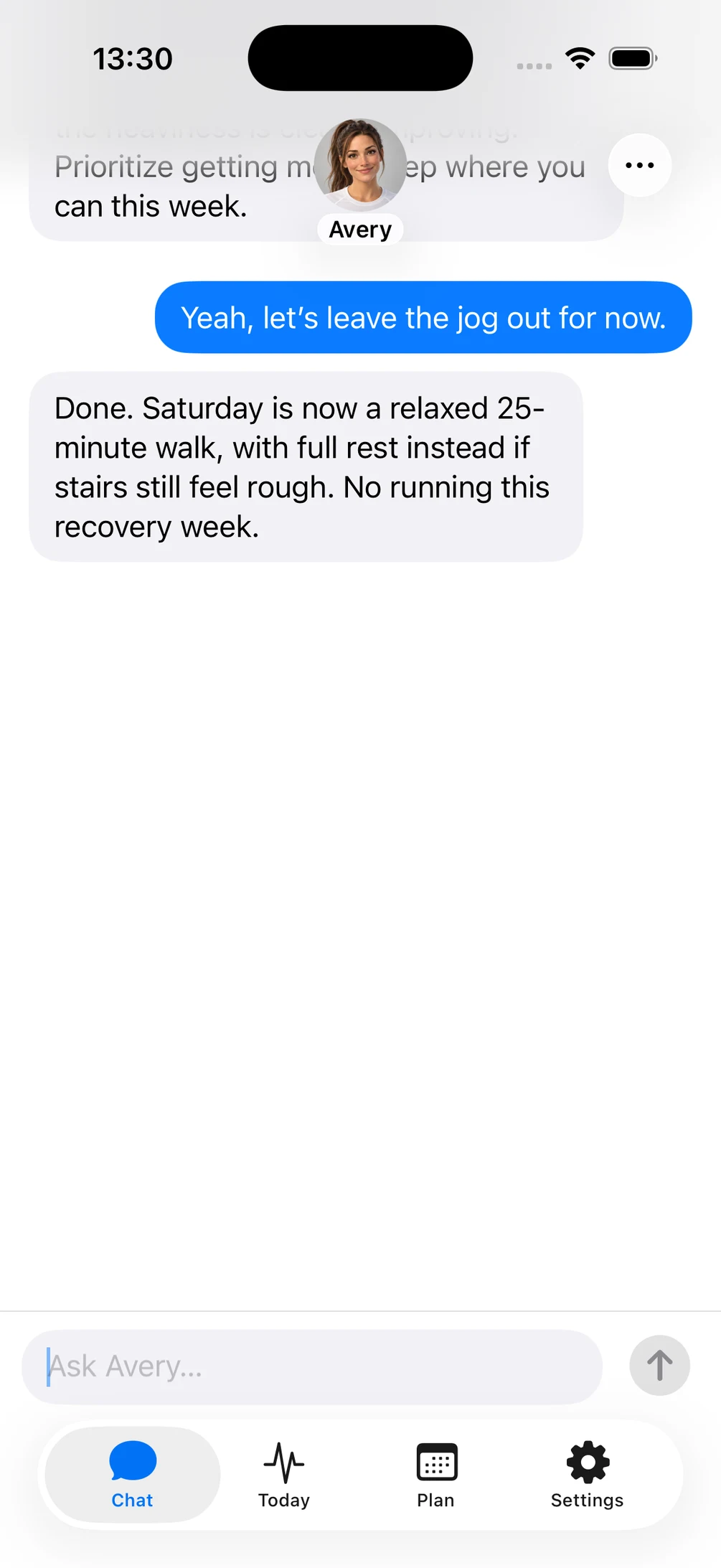
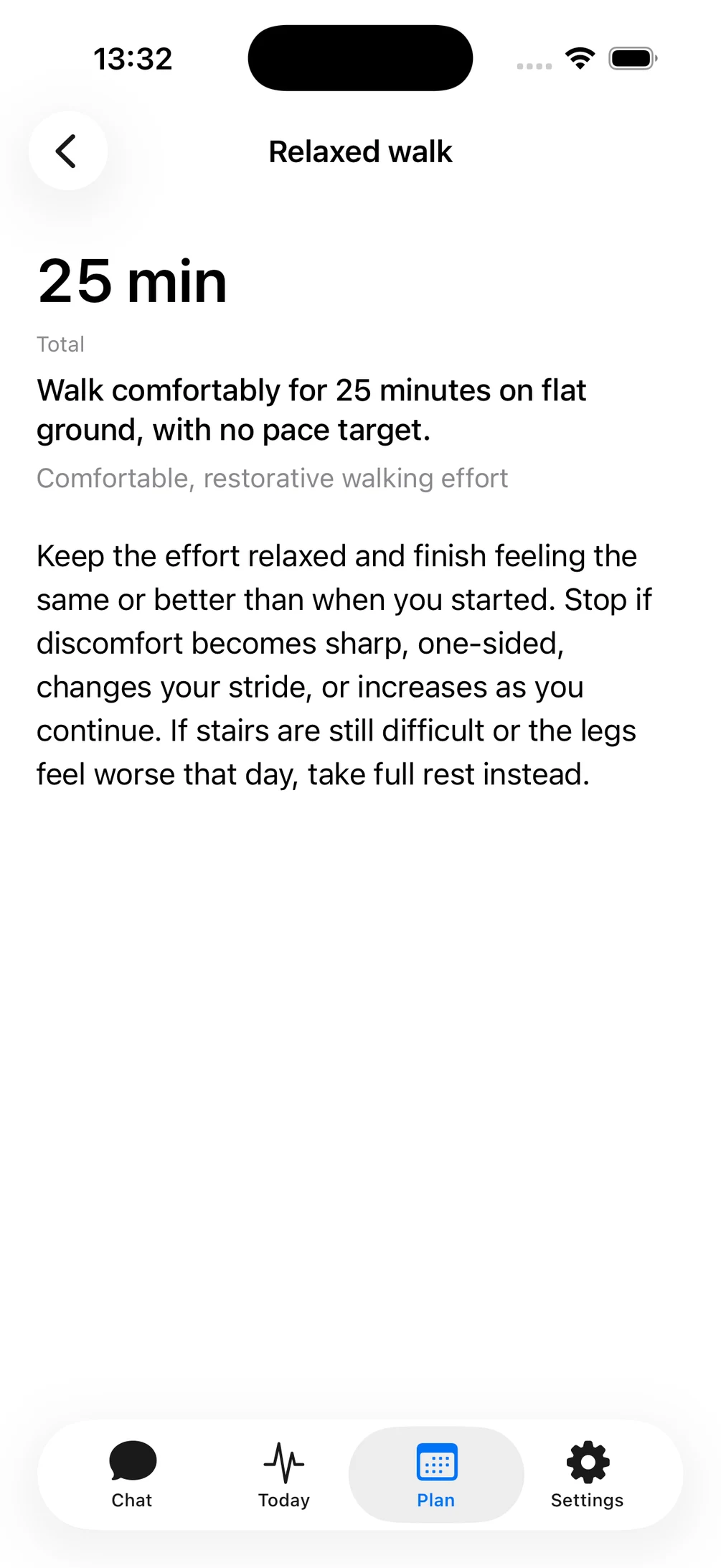
I added that stairs were still hard and I’d been sleeping about six hours. Avery checked the sleep records and still left a jog as an option. I’d have dropped it at that point. When I asked her to take it out, Saturday changed to a 25-minute walk, with the option to rest if stairs still hurt.
The recovery week saved in Plan
Here’s what the calendar showed for November 9–15, a week after New York.
| DAY | SAVED SESSION | WHAT TO KEEP IN MIND |
|---|---|---|
| Monday, Nov 9 | Rest | Normal daily walking is enough. |
| Tuesday, Nov 10 | Relaxed walk, 30 minutes | Flat ground, no pace target. Stop for worsening discomfort or changed movement. |
| Wednesday, Nov 11 | Rest | Rest from planned training. |
| Thursday, Nov 12 | Easy walk, 20 minutes, then gentle mobility | Only familiar, comfortable movements. Skip mobility if it makes the legs feel worse. |
| Friday, Nov 13 | Rest | Rest from planned training. |
| Saturday, Nov 14 | Relaxed walk, 25 minutes, or full rest | Take full rest if stairs are still difficult or the legs feel worse that day. |
| Sunday, Nov 15 | Rest | Optional relaxed daily walking, without turning it into a workout. |
Then I told Avery about the CIM bib. I asked to keep the recovery week and work out what to do between that and race day. Avery looked up the date. CIM is December 6, 2026, five weeks after NYC.
The rest days and Saturday walk stayed where they were. Avery added three weeks after them.
Keep recovering
Walking and rest. The adjusted recovery week stays in place.
Try short easy runs
Start only if the stated recovery conditions are met. Otherwise walk or rest.
Keep the work modest
Easy running, optional relaxed pickups and a conditional endurance check.
Reduce, then reassess
A taper, a short shakeout and an explicit decision about starting CIM.
This is the saved schedule for this illustrative case, not a four-week recovery prescription for everyone.
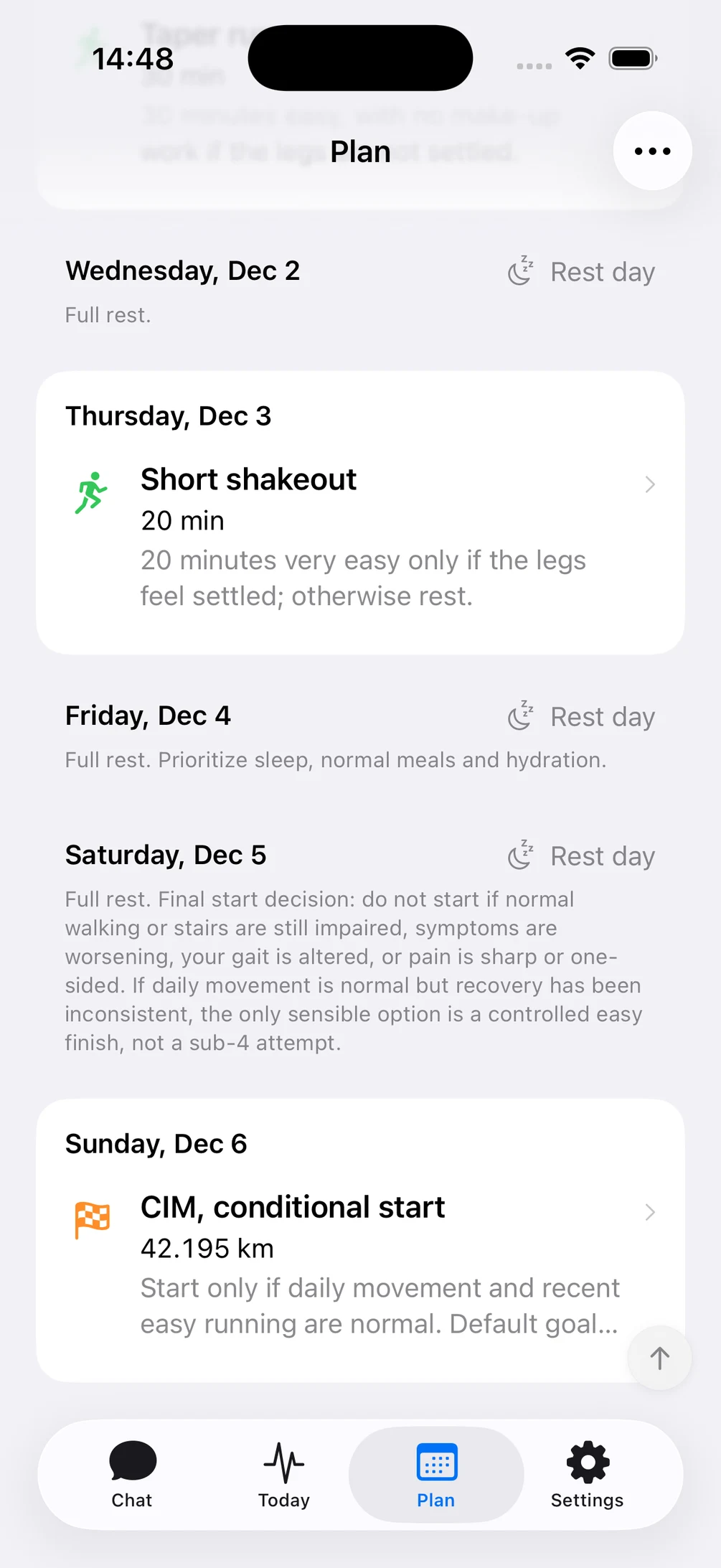
I looked at the CIM entry in Plan. Avery had put down an easy effort with walk breaks if needed, and left room for Kai to skip the start if he hadn’t recovered. There was no sub-four target. Five weeks earlier, he’d been 2 minutes and 58 seconds away.
More marathon recovery questions
How many days should I rest before running after a marathon?
Yale Medicine describes five to seven days off running as common advice, followed by short, easy runs. Some published guidance is more conservative. Treat the date as a check-in, not a deadline. Review walking, stairs, fatigue and symptoms first. After the first short run, leave time to see how you feel later and the next morning before planning more.
Will a week off running make me lose my marathon fitness?
There is no exact zero-loss allowance that fits everyone. Small studies of detraining and post-marathon recovery measure different things; a rough first run does not show that your training block has disappeared. Plan the return rather than chasing your old pace. Repeat manageable short runs, rebuild the routine before mileage, and save faster training for later.
Should I do a recovery run or take another rest day?
A recovery run is still a run. If walking or stairs remain difficult, or the last outing made the next morning worse, replace the planned run with rest or comfortable walking. When running is appropriate again, choose a short easy outing and check the response afterward. You do not need a run to complete a recovery day, and you do not owe the missed miles later.
Why does an easy run feel so hard even though my legs are no longer sore?
Less soreness does not establish that your usual running week is back. Leave the old pace target out, shorten the outing and record effort, heart rate, conditions and the next-morning response. Compare several comparable outings rather than one run or a friend's comeback. If difficulty persists, symptoms worsen or movement changes, seek professional assessment rather than trying to train through it.
My HRV is low, but I feel fine. What should I do?
Compare several readings with your own usual range, using the same device and comparable measurement conditions. Check the dates, sleep and recent activity. If the pattern remains unusual, review it before adding intensity. The 35 ms in the Today screenshot is not a universal target. A single HRV value or a green Recovery score cannot clear you for a hard run.
Can I go to the gym or cycle instead of running?
Keep any early activity familiar and gentle; a hard bike ride or heavy leg session can turn time off running into another demanding training day. Yale advises against starting a new workout immediately after the race and recommends a careful return to strength work. If an activity leaves you worse afterward, reduce it or leave it out rather than treating it as a substitute workout you must finish.
What should I eat and drink after a marathon?
Start with familiar food you can tolerate, including carbs and protein, then keep eating regular meals in the following days. Replace fluids gradually rather than forcing a huge drink at the finish. If a large meal sounds unappealing straight away, a familiar snack can be a useful start. Recovery nutrition continues beyond the celebration meal.
I can barely manage the stairs. Is it too soon to run?
Difficult everyday movement is a reason to leave the run out and reassess. Keep walking comfortable rather than chasing a step target. Persistent or worsening pain, or pain that changes how you move, deserves professional assessment. Chest pain, fainting or confusion needs urgent medical attention. A training plan or improving watch score is not a reason to work through those symptoms.
Can I run another marathon a month or five weeks later?
An entry and a calendar gap do not establish that you will be ready. Discuss whether you want to race for a time or take part at a controlled effort, and leave room to change the goal or skip the start. In the NYC-to-CIM test, the saved plan kept the recovery week, dropped the sub-four target and made starting conditional. It does not prove that five weeks is enough for another marathon.
Is there a free post-marathon recovery plan?
Hal Higdon offers free five-week plans for novice, intermediate and advanced runners. This article also has a four-stage guide and a printable recovery-week record. Use your recent readings, activity feedback and the following morning to review a plan before adding more. The Rayvik dates and durations shown here belong to one test case, rather than a schedule everyone should copy.
Sources & notes
I’m a runner and Rayvik’s founder. This is general information and a product walkthrough, not individual medical advice. The case uses simulated race and health records; it does not show my own NYC finish or an observed recovery outcome.
Free plans are available from Hal Higdon. The practical guidance draws on HSS, Yale Medicine, HSS’s reverse-taper explanation and NYRR’s coaching FAQ. Questions such as whether a recovery run is needed also came up in the linked Reddit discussions. Individual replies are not medical guidance.
The cartoons are AI-generated editorial illustrations. The research links beside the stretching, cold-water and immune-function sections explain the narrower findings discussed there; the illustrations are not clinical evidence.
I have a race on November 15 and plan to revisit this with my own post-race records. Until then, the screenshots are an illustrative planning case.