Use this hierarchy, not whichever number is easiest
| MAX-HR SOURCE | HOW TO USE IT | CONFIDENCE |
|---|---|---|
| Supervised maximal test | Best direct reference when testing is appropriate | Highest |
| Credible race / hard-session peak | Observed maximum; reject isolated sensor spikes | Useful lower-bound reference |
| Rayvik run-history estimate | Stable peaks across six months of Apple Watch runs | Convenient; can underestimate if you never run hard |
| Age equation | Fallback when no exercise data exists | Lowest for the individual |
Age formulas are widely used because they are available to everyone. They describe the centre of a population, while individual maximum heart rates can sit well above or below the estimate. The calculator uses 208 − 0.7 × age, but only after you deliberately choose the age fallback.
Why we recommend heart-rate reserve
The simple method takes a percentage of maximum heart rate. Heart-rate reserve first subtracts resting HR, applies the intensity percentage to the remaining range, then adds resting HR back. Two runners with the same maximum but very different resting heart rates therefore do not receive identical boundaries.
- Maximum HR. The highest credible heart rate reached at maximal effort—not average workout HR and not automatically one watch spike.
- Resting HR. Use a recent overnight or waking baseline; illness and accumulated fatigue can move it.
- Field check. Zone 2 should still allow full sentences. If breathing and the number disagree, investigate the inputs before chasing the watch.
Frequently asked questions
What is the best way to calculate Zone 2?
When you have a credible maximum heart rate and a recent resting heart rate, heart-rate reserve is a useful default because it includes both. A lab-measured first lactate or ventilatory threshold is more individual than either formula.
Is maximum heart rate the highest heart rate in a workout?
Maximum heart rate means the highest rate your heart can reach during maximal effort. A credible high value from a race or hard session can be a useful observed reference, but one noisy optical-sensor spike is not proof of your physiological maximum.
How accurate is maximum heart rate estimated from age?
Age equations summarize a population and can be meaningfully wrong for an individual. They are common because they require no exercise data, not because age determines your exact maximum heart rate.
How do I change heart-rate zones on Apple Watch?
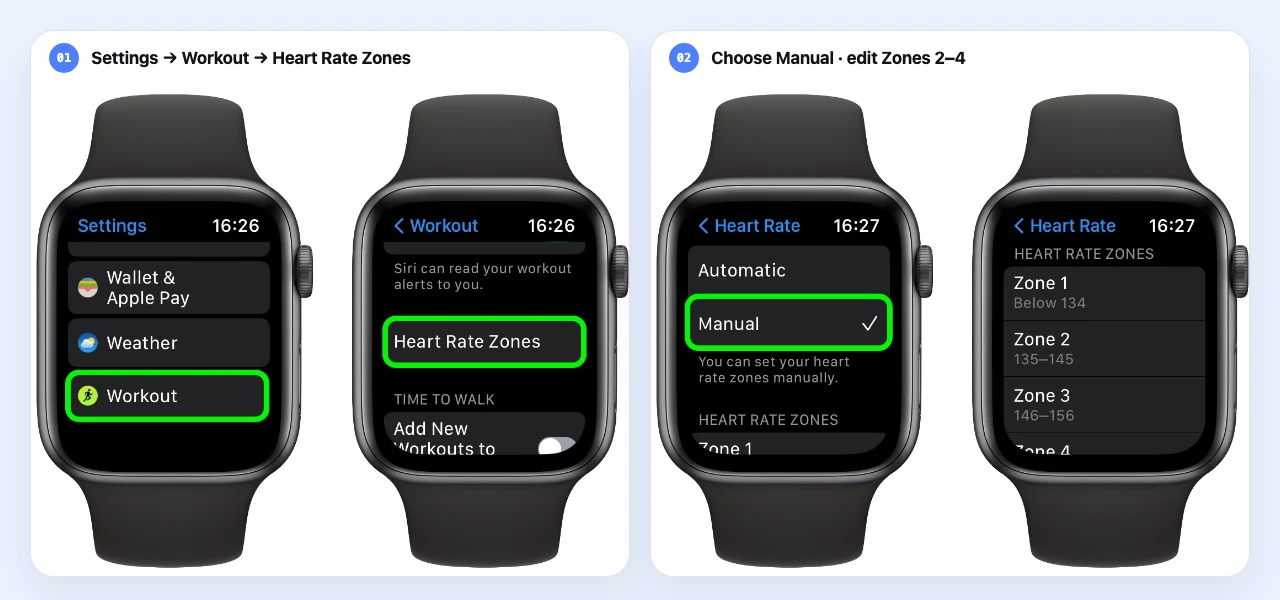
On iPhone: Watch → My Watch → Workout → Heart Rate Zones → Manual. On Apple Watch: Settings → Workout → Heart Rate Zones → Manual. Then edit Zones 2, 3 and 4.