Which 5K training plan do you need?
Start with the runner you are today: build up to your first 5K, or train to run a faster one. Each route needs a different plan.
Choose your route
I cannot run 5K continuously yet
Start with a simple run-walk plan on three well-spaced days each week. Ignore finish-time targets for now; the goal is to build a routine your body can repeat.
Best first step: follow a proven beginner progression.
I can finish 5K and want to get faster
Start from your recent result and normal weekly running—not your dream pace. Keep most running easy, then add a controlled dose of faster work and recovery.
Best first step: choose a plan matched to current fitness.
If pain is recurring, worsening or changing how you run, neither route is the right next step. No PDF, watch, app or AI should diagnose it.
Route 1: build up to your first 5K
You do not need a pace target, intervals or a complicated dashboard. Make 5Ksmaller: first learn to move for 20–30 minutes with run-walk breaks, then make1K, 2K and 3K feel slow and repeatable before chasing the full distance.
Watch effort and heart rate, not pace. You should be able to speak in full sentences; if breathing becomes strained or heart rate keeps climbing, slow to a shuffle or walk. Use our Zone 2 heart-rate calculator to estimate an easy range, but treat the number as a guardrail—not a pass-or-fail test. Wrist readings and formula-based zones are estimates, especially for beginners.
- 01Build a 20–30-minute run-walk habit. Jog very slowly, walk before you are exhausted and use three well-spaced sessions per week. The first win is finishing with energy left.
- 02Run 1K continuously—very slowly. There is no target time. Finish with controlled breathing and without a desperate sprint, then repeat it on another day before moving on.
- 03Extend the same effort to 2K. Do not run faster because the distance still looks short. A brief walk is the right adjustment when heart rate or breathing stops being controlled.
- 04Make 3K feel ordinary. Repeat it until you can recover normally by the next day. The milestone is not just reaching 3K; it is being able to train again.
- 05Complete your first 5K. Run-walk is still allowed. Keep the first half deliberately easy and finish without turning the final kilometre into a test. Speed belongs to Route 2.
These are milestones, not weekly deadlines. Move on when the current step has felt controlled on two separate runs, your gait stays normal and recovery is uneventful. Repeating a distance is training; it is not falling behind.
The most useful ideas to borrow from Nike are simpler than its pace tables: start every run easy, stop while you still feel good and treat recovery as part of training. Nike’s full eight-week 5K plan mixes recovery runs, long runs, speed work and rest—and introduces speed sessions from the opening week. We borrow its mindset for Route 1, not that full workload. The complete plan fits Route 2 better once continuous running is already established.
If you want a ready-made beginner schedule, our clearest recommendation remains the free NHS Couch to 5K programme: a nine-week run-walk progression built around three runs per week. If it progresses faster than your body or schedule allows, repeat a session or week rather than treating the calendar as a deadline.
Prefer not to manage every milestone and recovery decision yourself? See how Rayvik turns your goal, training load and recovery into a clear next step.
Route 2: train for a faster 5K
If your next goal is a half marathon, a recent all-out 5K can also help you choose an initial target. Use the half marathon time predictor to compare that race result with your longer-distance training; a recent 10K gives you a closer reference when you have one.
If you already run 5K, the plan should begin with what you can do now: your recent result, normal weekly volume, available days and recovery. Goal pace is a destination, not the correct intensity for every hard repetition from day one.
Consider a fictional runner who has trained three days a week for several months, averages 20–24 km, has no current pain and recently ran 28:00. They have10 weeks to aim for sub-26:00. Current pace is 5:36/km; goal pace is5:12/km. That 24-second-per-kilometre gap is why the opening sessions should be calibrated to current fitness rather than ambition.
The ordinary week, before life happens
35 min easy, then 4×20 sec relaxed strides
Full sentences; finish fresher than you started
5×3 min at current 5K effort, 2 min easy between
Controlled 7–8/10, never a sprint
50–55 min at conversational effort
Duration matters more than defending a pace
20–30 min of familiar, progressive exercises
Support the running; do not create a second hard day
- Protect the easy running. Most running should stay comfortable enough to recover from. Hills, heat and fatigue can all make pace a poor guide.
- Give faster work one clear job. Use a controlled session to develop 5K-specific fitness; do not turn every run into a test of goal pace.
- Progress only what you can absorb. A better result may justify a small pace change. It does not automatically justify more hard running and more volume at once.
- Keep recovery inside the plan. Rest, easy days and optional strength have to fit around the quality session instead of becoming extra hard days.
Start by previewing a free, level-matched structure such as the Nike Run Club 5K plan or Hal Higdon's levelled plans. Pay for an app only when it solves a real extra problem, such as workout delivery, schedule repair or adaptation from completed training.
The rule both routes share: training load needs recovery
Beginners and experienced runners make the same mistake. A new goal creates a burst of motivation, so every run gets longer or faster and rest starts to feel like lost time. For a while, effort can hide the accumulating cost. Then easy runs feel hard, a small niggle becomes persistent pain, training stops—and the goal is abandoned.
Enough stress to create change
Load is more than kilometres. Frequency, duration, intensity, long runs and strength all add to what your body has to absorb. Progress needs a useful stimulus—not the maximum amount of work you can survive today.
Enough capacity to absorb it
Recovery is not time wasted. Sleep, soreness, resting heart rate, HRV, motivation and how an easy run feels all help describe your response. When recovery falls behind, adding more load usually deepens the gap instead of building more fitness.
You do not need to become a sports scientist or make one wearable score the boss. The useful question is simpler: does today's planned load fit how I am recovering?
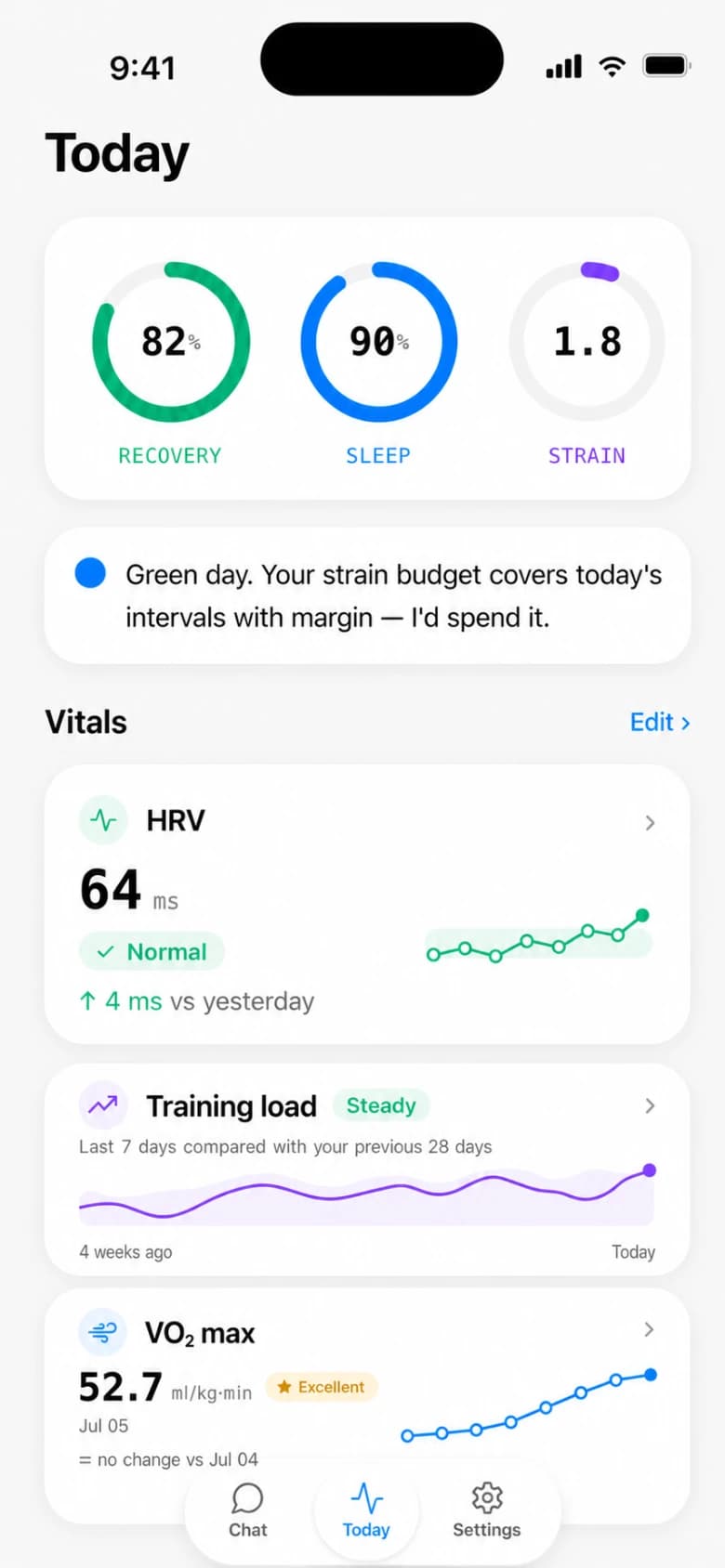
Know whether today is a push day or a recovery day.
Today puts your recent training load beside recovery signals, then turns the combination into one clear coaching decision. You do not have to interpret every chart before deciding whether to complete, reduce or replace the planned session.
What recent running and strength work have already asked from you.
How sleep, HRV, resting heart rate and your own feedback suggest you are responding.
If you still want to compare plan formats
| YOUR SITUATION | START WITH | WHY | WATCH FOR |
|---|---|---|---|
| Your week is predictable and you are comfortable adjusting it | A free published plan | Transparent, easy to preview and often enough | You must decide what to do after missed training |
| You want workouts delivered cleanly to a calendar or watch | A plan app or compatible watch coach | Less friction, reminders and guided execution | Polished delivery does not guarantee individual decisions |
| Your schedule, recovery or completed training changes often | An inspectable adaptive system | Can revise the next decision from changing context | Avoid changes that are unexplained, irreversible or too confident |
These are starting points, not product rankings. Features vary by subscription, device, plan and version.
A general chatbot is useful for explaining a workout or helping you rewrite a week, but it only knows the training, fatigue, schedule and pain history you remember to provide. Fluent conversation is not the same as automatic observation.
The useful test: what happens when the week breaks?
Most plans look sensible when every session is completed. Before paying, check whether the plan can help with the decisions runners actually face.
- You miss the quality session. The plan should help you move, shorten or skip it without compressing hard days or creating training debt.
- You run a much faster 5K. A small, visible pace adjustment may be sensible. One result should not increase pace, volume and intensity together.
- Recovery looks poor and running feels harder. Use the combined signal—sleep, recent training, subjective effort and run response—then reduce the next session and reassess.
- Pain worsens or changes your stride. The plan should stop escalating training and state its boundary. That is a reason for appropriate clinical assessment, not an AI diagnosis.
Why these recommendations are conservative
Progression should be gradual and individual. The ACSM position stand does not turn that principle into one universal mileage formula, and research on changes in weekly distance, frequency and intensity remains conflicting. A recent prospective cohort found a signal around abrupt increases in one run, but it does not prove a magic 10% rule.
Comfortable speech is a useful field check for easy aerobic running, although the talk-test evidence does not make it a precise laboratory threshold. Faster intervals can improve fitness, but a systematic review in recreational runners supports combining them with continuous running rather than making every session hard.
Some strength methods can improve running performance, according to a 2024 meta-analysis, but that is not a promise of injury prevention. For the final week, a 2023 taper meta-analysis supports reducing volume while retaining some intensity; recreational runners should apply the principle conservatively rather than copy one exact percentage.
How we made these recommendations
This is an editorial framework, not a clinical trial or a claim that we completed every named plan. The fictional sub-26 runner keeps the comparison consistent. Current plan and product documentation supports feature descriptions; the research above informs our training criteria but does not prove that a particular app will improve your race time.
I have run for eight years, trained for half marathons and marathons, and used Garmin and general chatbots in my own training. I also build Rayvik. Where I have not used a feature firsthand, this article relies on the plan itself or the maker’s current documentation and says what the evidence can—and cannot—support. A transparent static plan remains the better choice when it solves the runner’s actual problem.
5K training plan FAQs
What is the best 5K training plan?
There is no universal winner. A first-time runner usually needs a simple run-walk progression and consistency. A runner chasing a faster time needs a plan matched to current volume, a controlled amount of faster work and clear recovery. Choose the simplest plan that fits your current running and can explain what to do when the week changes.
How long should a 5K training plan be?
Published plans vary. NHS Couch to 5K uses 9 weeks, while the Nike Run Club and Hal Higdon 5K schedules use 8 weeks. The right runway depends on whether you are starting from walking, already run consistently or are sharpening for a time goal. It is fine to repeat a week or extend the plan when your body or schedule needs it.
Can I train for a 5K by running three days a week?
Yes. Three well-spaced days can be enough to build toward a first 5K, and the NHS Couch to 5K plan uses that structure. A faster runner may benefit from more running, but only when that frequency fits their recent training history and recovery. More days are not automatically a better plan.
Should a beginner train for a 5K by pace or heart rate?
Use breathing and perceived effort first, with heart rate as a guardrail rather than chasing a pace. Most early running should feel conversational. If heart rate keeps climbing or you cannot speak comfortably, slow down or walk. Formula-based zones and wrist readings are estimates, so do not treat one watch number as a pass-or-fail test.
Should I make up a missed 5K workout?
Do not automatically cram it into the next available day. First protect recovery around demanding sessions. You can move the workout when enough space remains, replace it with an easier run, or skip it and continue. One missed session usually costs less than turning several days into one compressed hard block.
Can AI make a good 5K training plan?
A chatbot can draft and explain a plausible plan when you provide enough context. That does not make it an automatic coach: you may still need to supply completed runs, fatigue, schedule changes and pain history each time. An adaptive product is more useful only if its data, changes, limits and athlete controls are clear.
Is going from a 28-minute to a 26-minute 5K in 10 weeks realistic?
It is a reasonable worked goal for some consistent runners, but it is not a promise. The gap is 24 seconds per kilometre, and the result depends on training history, course, weather, recovery and how close the 28-minute effort was to current ability. Build from current fitness rather than treating 26-minute goal pace as the starting prescription.
Sources & notes
We build Rayvik. Plan details were checked against official sources on July 23, 2026; training judgments draw on the research linked in the article. We use no affiliate links.
References: NHS Couch to 5K, Nike 5K plan, Hal Higdon 5K plans, Runna guidance and Garmin documentation. Corrections: hey@rayvik.app.
This guide is general education, not individual medical advice. Pain or concerning symptoms need appropriate medical care, not a training-plan adjustment. See guidance from the NHS and American Heart Association.