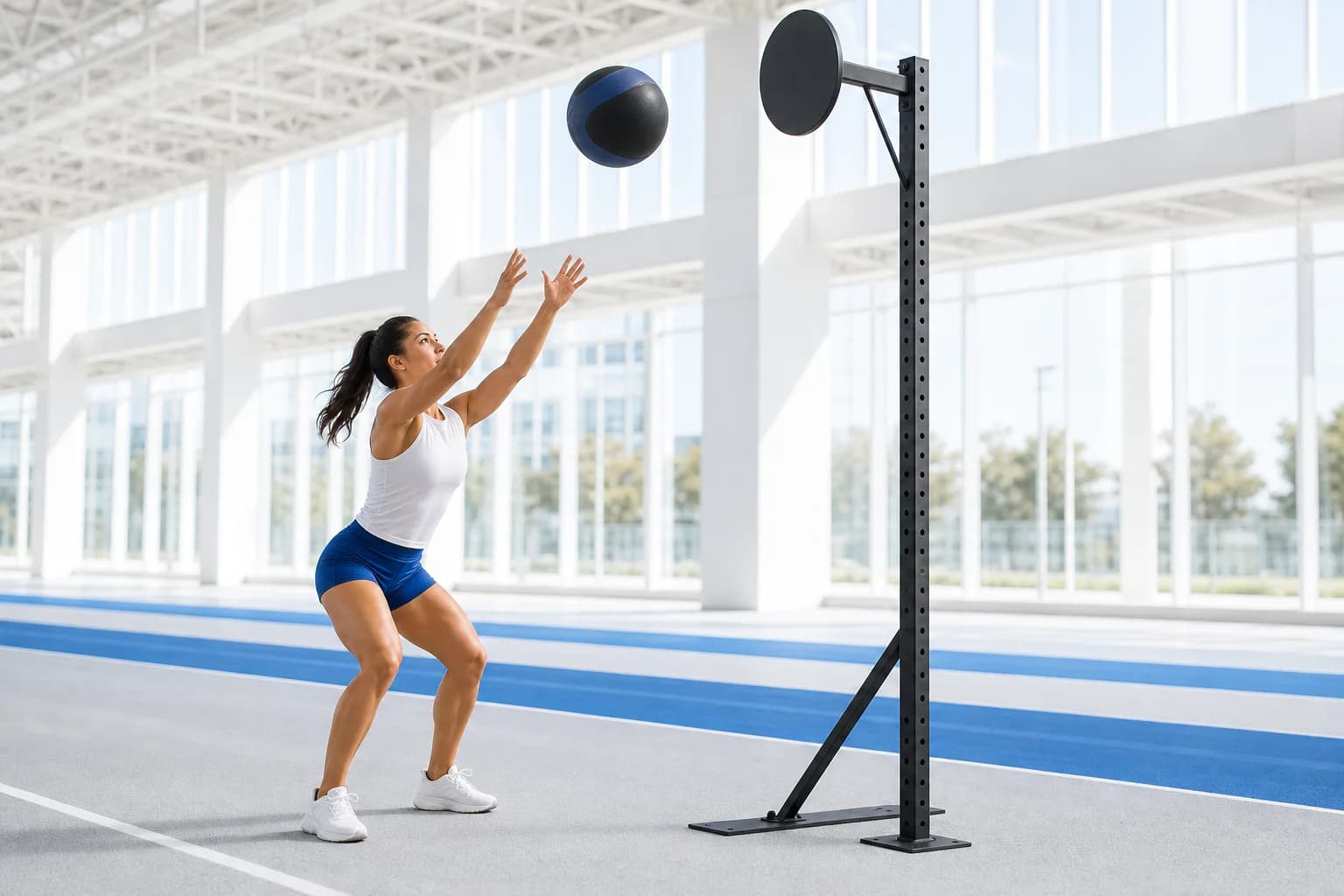
HYROX wall balls: rules, pacing and the run after
Wall balls are the final station: 100 valid repetitions after 8 km of running and seven prior stations. The challenge is standards under fatigue, not discovering a new squat technique on race day.
Official format
| DIVISION | WOMEN | MEN |
|---|---|---|
| Open | 4 kg | 6 kg |
| Pro | 6 kg | 9 kg |
Current published Singles format, checked August 7, 2026. Verify the latest official rulebook.
Movement standards to rehearse
- Reach squat depth. The hip must meet the current movement standard before the athlete stands and throws.
- Hit the target. The ball must contact the prescribed target area for the repetition to count.
- Own the catch. Receive the ball under control and connect the next squat only while the standard remains repeatable.
How to pace the station
Practise valid movement before optimizing speed. The useful target is the fastest effort you can repeat without damaging the next run. Use the HYROX race simulator to budget the running, stations and Roxzone together.
Common first-race mistakes
- One giant opening set. An ambitious first set often creates more total rest than planned smaller sets.
- Standing too close. The ball path becomes steep and the catch punishing; practise a repeatable distance from the wall.
- Waiting for failure. Break before technique collapses, especially if no-reps are starting to appear.
What it does to the running
There is no run after wall balls, which tempts athletes to arrive at the station already overdrawn. The better trade is often a controlled final kilometre that preserves enough breathing and leg coordination to keep repetitions valid.
Plan your first race
Frequently asked questions
How many wall balls are in HYROX?
Singles athletes complete 100 wall balls at the final station.
What weight are HYROX wall balls?
The 2026/27 Singles format lists 4 kg for Women Open, 6 kg for Women Pro and Men Open, and 9 kg for Men Pro. Verify the current rulebook for your event and division.
Should I do 100 wall balls unbroken?
Not unless that is already a reliable fatigued skill. Planned sets with short, controlled breaks are generally safer than reaching failure and accumulating no-reps.
Continue through the race
 All 8 HYROX stations →See the full race order, weights and standards in one place.
 Previous: HYROX sandbag lunges →100 m · alternating walking lunges
HYROX is a brand of HYROX World GmbH. Rayvik is independent and is not affiliated with, sponsored by, or endorsed by HYROX.